
AM Oktarina Counsellors at Law’s Participation in ET Asia Webinar Admiralty Law and Jurisdiction: Admiralty Jurisdiction & Arrest and Release of Vessels
Contributors : Pramudya Yudhatama, S.H., C.L.A., and Anis Sambuaga Telaumbanua, S.H.
Reviewer : Noverizky Tri Putra Pasaribu, S.H., LL.M. (Adv.) and Febrianda Pasaribu M.Sc.
On Friday, September 19th, 2025, AM Oktarina Counsellors at Law (“AMO”) once again demonstrated its active role in advancing legal knowledge by participating in a dedicated forum on admiralty law and jurisdiction. The event, titled “Admiralty Law and Jurisdiction: Admiralty Jurisdiction & Arrest and Release of Vessels,” brought together legal professionals, academics, and stakeholders in the maritime sector to reflect on the evolving nature of Indonesia’s maritime legal framework in relation to international standards. The session was led by Mr. Noverizky Tri Putra Pasaribu, S.H., LL.M. (Adv.), Founding Partner of AMO, whose expertise and international exposure positioned him uniquely to shed light on one of the most complex areas of modern law the regulation of disputes and enforcement mechanisms in maritime contexts.
As Mr. Noverizky explained, Indonesia’s position as an archipelagic state, intersecting with vital international sea lanes, inevitably produces legal challenges. These include disputes over navigation, vessel collisions, environmental damage, contractual breaches, and even piracy. Such matters fall under Admiralty Law, a specialized body of rules governing activities at sea. Admiralty Jurisdiction (“AJ”) not only defines the scope of authority of courts over maritime disputes but also determines the applicable remedies when incidents occur in national or international waters. Quoting international definitions, admiralty law encompasses navigation, commerce, and trade on navigable waters, regulating issues from contracts of carriage to personal injury claims, and from salvage operations to ship arrests. For Indonesia, where approximately 90% of trade depends on sea transport, legal certainty in this domain is essential for economic stability and investment security.
The legal basis for admiralty jurisdiction in Indonesia is complex, reflecting the interplay between domestic statutes and international conventions. Among the national instruments are the Commercial Code/Kitab Undang-Undang Hukum Dagang (“KUHD”), the Criminal Code/ Kitab Undang-Undang Hukum Pidana (“KUHP”), and the Criminal Procedure Code/Kitab Undang-Undang Hukum Acara Pidana (“KUHAP”), all of which contain provisions that can intersect with maritime disputes. More specialized laws include Law No. 17 of 2008 on Shipping, which has recently been amended by Law No. 66 of 2024, strengthening Indonesia’s approach to maritime regulation; Law No. 32 of 2014 on the Sea, amended by Law No. 6 of 2023; and Law No. 45 of 2009 on Fisheries, also amended by Law No. 6 of 2023. These are supported by Law No. 30 of 1999 on Arbitration and Alternative Dispute Resolution and Law No. 2 of 1986 on General Courts, which establish procedures and jurisdiction for dispute resolution. At the international level, Indonesia is bound by the United Nations Convention on the Law of the Sea 1982 (“UNCLOS”), which provides the global framework for maritime jurisdiction, and while it has not ratified the International Convention on Arrest of Ships 1999 (“ICAS”), the provisions of that treaty nonetheless serve as important reference points for comparative practice.
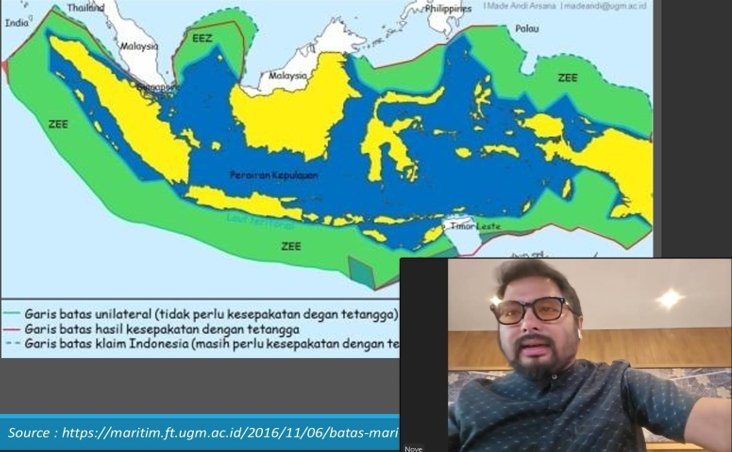
Drawing from these sources, admiralty jurisdiction in Indonesia spans a broad geographical and legal spectrum. Domestically, it covers internal waters, archipelagic waters, and the territorial sea, areas over which Indonesia exercises full sovereignty. Beyond these zones, Indonesia maintains sovereign rights and certain jurisdiction over the contiguous zone, which extends 24 nautical miles from its baselines, and over the Exclusive Economic Zone (“EEZ”), which stretches to 200 nautical miles. Indonesia also has rights over its continental shelf, which under UNCLOS can extend up to 350 nautical miles in certain cases. Within these maritime zones, Indonesia enforces its jurisdiction over navigation, commerce, natural resource management, and the prosecution of offenses. This complex layering of jurisdiction underscores the breadth of Indonesia’s maritime responsibilities, as well as the need for robust mechanisms to implement and enforce its legal authority.
Internationally, however, admiralty jurisdiction is subject to principles of international law that limit coastal states’ powers and recognize the responsibilities of flag states. As highlighted during the session, UNCLOS Article 94 places responsibility on flag states to effectively exercise jurisdiction and control over ships flying their flag, in administrative, technical, and social matters. Article 217 further requires flag states to investigate violations of international standards committed by their vessels, regardless of where the violations occur. Article 97 provides that in cases of collisions or navigation incidents on the high seas, only the flag state or the state of nationality of the crew may exercise penal or disciplinary jurisdiction. At the same time, Article 100 obliges all states to cooperate in the suppression of piracy, making maritime security a shared global responsibility. The doctrine of hot pursuit, as articulated in Article 111, further illustrates how coastal states may pursue foreign vessels into the high seas when violations occur within their waters, provided the pursuit is continuous and lawful. These provisions illustrate the delicate balance between the sovereignty of coastal states like Indonesia and the overarching principles of freedom of navigation that underpin international maritime law.
One of the most technically demanding areas of admiralty jurisdiction is the arrest and release of vessels. Mr. Noverizky devoted considerable attention to explaining the differences between the ICAS 1999 framework and Indonesian domestic law. Under ICAS 1999, arrest is defined as the detention of a ship by order of a court to secure a maritime claim, and may only be ordered in respect of specific maritime claims. Once sufficient security is provided, the ship must be released. Importantly, ICAS provides that even if disputes are subject to arbitration or foreign courts, a ship may still be arrested to secure the claim in the state where it is located. Indonesia, however, has not ratified ICAS 1999, and thus relies on its domestic legal framework. Under Law No. 17 of 2008 and its 2024 amendments, ship arrest (penahanan kapal) can only occur upon written order of a court. Grounds for arrest include criminal and civil maritime claims, such as collisions, environmental damage, loss of life, unpaid wages, salvage operations, contractual breaches, and even disputes over ship mortgages and ownership. The release of ships similarly follows Indonesian procedural law, where courts determine the adequacy of security. This creates a distinctive legal regime that investors and shipping companies must navigate, as it reflects Indonesia’s sovereignty while also diverging from internationally harmonized standards.
Admiralty disputes frequently require multi forum solutions. In Indonesia, jurisdiction may fall under the District Court (Pengadilan Negeri) for both civil and criminal matters, ranging from mortgage enforcement on ships to contractual breaches at sea. Arbitration also plays a central role, particularly through the Indonesian National Arbitration Board/Badan Arbitrase Nasional (“BANI”), where maritime contracts contain arbitration clauses.
Special mention was given to the Maritime Court (Mahkamah Pelayaran), which examines ship accidents and enforces professional codes of conduct for captains and officers. On the
international plane, disputes may escalate to the International Tribunal for the Law of the Sea (ITLOS) in Hamburg, which adjudicates cases under UNCLOS, including seabed disputes and prompt release of detained vessels.
Notably, Mr. Noverizky introduced participants to the role of Baltic International Maritime Council (“BIMCO”) contracts, such as Shipman and Crewman agreements, which frequently become sources of arbitration and litigation in maritime disputes, underscoring the commercial dimension of admiralty jurisdiction.
Perhaps the most technical but crucial discussion revolved around ship arrest and release mechanisms. Internationally, the ICAS outlines that arrest may only occur under court authority and solely for maritime claims, such as damage caused by vessel operations, unpaid crew wages, or environmental harm. Release, conversely, is contingent upon adequate security or guarantees.
Indonesia, however, has not ratified ICAS 1999. Instead, its domestic laws, particularly Law No. 17 of 2008 as amended by Law No. 66 of 2024, regulate arrest through court orders executed by port authorities (syahbandar). Claims recognized under Indonesian law include cargo damage, charter disputes, collision liabilities, salvage costs, environmental damage, and wage claims, among many others. This robust list ensures that maritime creditors from crew members to financiers retain enforceable rights against vessels. The webinar also addressed controversial practices such as the sinking of illegal fishing vessels, permitted under Indonesian fisheries law (Law No. 45 of 2009), which underscores the assertive stance Indonesia has taken in safeguarding its maritime resources.
In reflecting critically on these frameworks, Mr. Noverizky underscored the dual challenge facing Indonesia. On one hand, the state must vigorously protect its sovereignty, enforce its jurisdiction, and secure its resources, particularly in the face of illegal fishing, marine pollution, and unauthorized foreign activity. On the other hand, Indonesia must also provide legal certainty and predictability to attract foreign investment and facilitate international trade. Ship arrest rules, dispute resolution mechanisms, and the recognition of international norms all play into this balance. The strengthening of the Maritime Court and the refinement of Indonesia’s legal provisions on ship arrest reflect steps toward greater coherence and credibility, but challenges remain, especially as investors seek clarity and predictability in an environment where domestic law does not always align with international conventions.
Ultimately, the session highlighted that admiralty jurisdiction is not an abstract legal topic but a living framework that shapes Indonesia’s economic and political destiny. By ensuring effective jurisdiction over its waters while aligning with global practices, Indonesia can safeguard its national interests while establishing itself as a reliable partner in the international maritime community. For AMO, participation in this forum reinforced its commitment to providing thought leadership in areas that are strategically vital to the country. With deep
expertise in corporate, commercial, and maritime law, and with continuous engagement in both domestic and international platforms, AMO remains dedicated to supporting clients, stakeholders, and policymakers in navigating the complexities of admiralty law.
The forum concluded with gratitude to Mr. Noverizky Tri Putra Pasaribu, S.H., LL.M. (Adv.) for his comprehensive presentation, and to all participants who joined in enriching the dialogue on one of the most vital areas of Indonesian and international law.
Presentation file : 1 Admiralty_Law_and_Jurisidction.by.AMO.18.09.2025
For further information, please contact:
– 081777912