
AM Oktarina Counsellors at Law at ET Asia Webinar: Collision and Salvage Operations
Contributors : Pramudya Yudhatama, S.H., C.L.A., and Anis Sambuaga Telaumbanua, S.H.
Reviewer : Noverizky Tri Putra Pasaribu, S.H., LL.M. (Adv.) and Febrianda Pasaribu M.Sc.
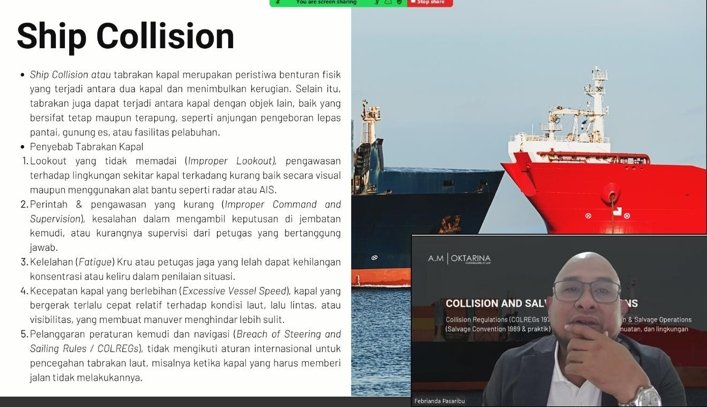
On Tuesday 23th September 2025, the ET Asia Webinar once again hosted Mr. Febrianda Pasaribu M.Sc., Managing Partner of AM Oktarina Counsellors at Law (“AMO”), to speak on a subject that sits at the very heart of maritime safety Collision and Salvage Operations. His lecture was not delivered as a dry legal text but as a vivid narrative about risk, responsibility, and resilience on the seas.
From the outset, Mr. Febrianda reminded the audience that the ocean functions as the world’s busiest highway. Around ninety percent of global goods are carried by ships. Every car manufactured, every barrel of oil transported, every ton of grain exported depends on maritime transport. Yet, this immense flow of goods brings with it an equally immense danger collisions between vessels, accidents that endanger lives and property, and incidents that threaten fragile marine ecosystems.
To meet these risks, maritime law has long relied on two fundamental pillars of international regulation. The first is the International Regulations for Preventing Collisions at Sea, 1972
(“COLREGs”), often described as the traffic code of the oceans. The second is the International Salvage Convention of 1989, which governs not only the saving of ships and cargo but also the protection of the marine environment. Indonesia has fully integrated both instruments into its domestic legal framework, ensuring that its waters are regulated in accordance with international standards through the Shipping Law, government regulations, and ministerial decrees. Collisions are often imagined as rare, freak accidents unavoidable consequences of bad luck or natural forces. But as Mr. Febrianda emphasized, the truth is far more sobering most collisions are the product of human error.
A ship colliding with another vessel, with a port structure, or with an offshore installation is usually the result of mistakes that could have been prevented. Perhaps a lookout was not maintained properly. Perhaps the master’s judgment was clouded by fatigue. Perhaps an officer failed to obey the rules of the road or a vessel proceeded at unsafe speed for the conditions. Whatever the cause, the consequences can be catastrophic loss of life, destruction of valuable property, and devastating oil spills that poison coastlines and ecosystems.
Even the most technologically advanced navies and shipping companies are not immune. The 2017 collision between the USS Fitzgerald and a container ship near Japan served as a stark reminder. Despite sophisticated radar and advanced navigation systems, fatigue and failure to follow COLREGs led to tragedy. It underscored a timeless truth no technology can replace vigilance, discipline, and respect for the rules.
The COLREGs, which Indonesia ratified in 1979, provide the unspoken order that governs movements at sea. They define responsibilities in crossing situations, head on encounters, overtaking maneuvers, and navigation in narrow straits. They require that every vessel keep a proper lookout at all times, adjusting speed to prevailing circumstances such as visibility, traffic density, and maneuverability.
The rules demand early and decisive action to avoid collision. They establish a hierarchy of vessels, ensuring that those constrained by draft, engaged in fishing, or restricted in maneuverability are given priority over vessels that can more easily alter course. These rules form a shared language of predictability, preventing chaos in crowded waterways such as the Malacca Strait, Sunda Passage, and Lombok Strait, where hundreds of ships pass daily.
As Mr. Febrianda noted, these rules are more than abstract regulations. They are lifelines. They transform the ocean from a lawless expanse into a highway governed by discipline and mutual respect. Without COLREGs, modern maritime traffic would collapse under its own density.
Even with rules in place, collisions still occur. When they do, international and domestic law impose strict obligations on shipmasters. Under United Nations Convention on the Law of the Sea 1982 (“UNCLOS”) and Indonesian law, the master must render assistance to the other vessel if possible, broadcast distress signals, report the incident to the nearest harbour authority, and maintain precise documentation of events.
Failure to meet these duties is not only a breach of maritime ethics but also a source of liability. In Indonesia, the Marine Court (Mahkamah Pelayaran) investigates collisions by examining radar logs, testimony, voyage data recorders, and witness statements. Its findings can result in suspension of licenses, disciplinary sanctions, and referrals to criminal prosecution.
Civil liability is governed by the Indonesian Commercial Code/Kitab Undang-Undang Hukum Dagang (“KUHD”). If one vessel is at fault, it bears the full loss. If both are at fault, damages are apportioned according to responsibility. If fault cannot be determined, losses are shared equally. Importantly, even the presence of a compulsory pilot does not absolve shipowners of liability ultimate accountability rests with those who operate and profit from the vessel.
This principle ensures that no one can hide behind technicalities when lives and livelihoods are at stake. Responsibility follows ownership, reinforcing the duty of care owed by every shipmaster and shipowner on the seas. If collisions represent the failure of prevention, salvage represents the hope of recovery. Salvage is defined in Indonesian law as assistance rendered to a ship in distress, whether afloat, stranded, or sunk. It includes the removal of wrecks and obstructions that threaten safe navigation. Crucially, salvage is not a free for all. Only licensed and permitted companies may carry it out, ensuring that operations are conducted with professionalism, accountability, and safety.
The purpose of salvage goes far beyond saving property. It is about mitigating economic loss, protecting the environment, and ensuring navigational safety. Consider a stranded oil tanker leaking fuel without prompt and effective salvage, the incident could escalate into an environmental disaster. Salvage may involve patching hulls, pumping out seawater, offloading cargo, or towing vessels to safer waters.
Salvage operations typically proceed step by step. First, teams assess stability, pollution risks, and weather conditions. Then, specialized assets tugboats, divers, cranes, pumps are deployed. Depending on the scale of the emergency, operations can last hours, days, or even weeks. Once completed, the vessel and cargo are surveyed, damages are assessed, and control is returned to the owner.
One of the most significant developments in salvage law has been the recognition of environmental salvage. The Salvage Convention of 1989 introduced the principle of special compensation even if salvors fail to save the ship or cargo, they may still be rewarded if their efforts reduced or prevented environmental damage.
For Indonesia, a nation with sensitive coral reefs, vital fisheries, and thriving coastal tourism, this provision is indispensable. It ensures that salvors are motivated not only by commercial gain but also by environmental stewardship. Mr. Febrianda recalled cases where salvage teams deployed oil booms, transferred hazardous cargo, and neutralized chemicals to prevent ecological disaster. Thanks to the Salvage Convention, such operations are not charity but legally recognized acts deserving compensation.
In his conclusion, Mr. Febrianda drew the two themes together. Collisions and salvage are not separate silos of maritime law but two halves of a single system. Collisions highlight the importance of prevention discipline, vigilance, and adherence to COLREGs. Salvage highlights the importance of recovery professionalism, preparedness, and environmental responsibility. Both are backed by international conventions, both are incorporated into Indonesian law, and both serve the higher goals of protecting life, safeguarding property, and preserving the marine environment.
“The sea will always be unpredictable,” he reflected. “Technology will never eliminate risk entirely. But the law provides order amidst uncertainty. The ocean is vast and unforgiving yet through law, discipline, and professionalism, we can make it safer for all who sail upon it.” The webinar closed not with fear, but with a profound respect, respect for the sea, for the lives it carries, and for the laws that safeguard its use for generations to come.
Presentation File : 5 Materi Webinar ET-Asia – Bapak Febrianda (Collision and Salvage Operation)
For further information, please contact:
– 081777912