
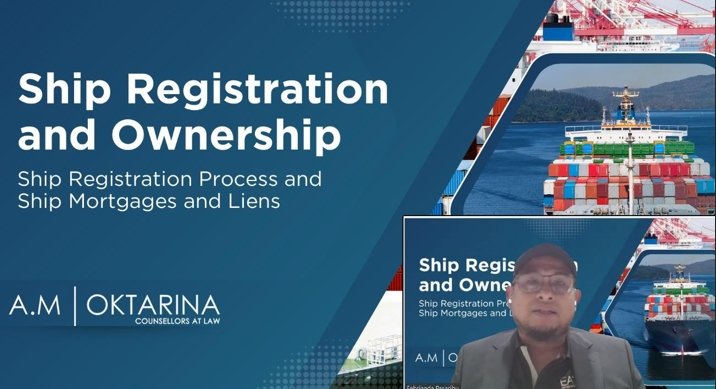
AM Oktarina Counsellors at Law at ET Asia Webinar: Ship Registration, Ownership, Mortgages, and Maritime Liens
Contributors : Pramudya Yudhatama, S.H., C.L.A., and Anis Sambuaga Telaumbanua, S.H.
Reviewer : Noverizky Tri Putra Pasaribu, S.H., LL.M. (Adv.) and Febrianda Pasaribu M.Sc.
On Friday 19th September 2025, the ET Asia Webinar welcomed participants from across the region to hear Mr. Febrianda Pasaribu M.Sc., Managing Partner at AM Oktarina Counsellors at Law (“AMO”), deliver a lecture on one of the most fundamental pillars of maritime law, Ship Registration and Ownership, including Mortgages and Maritime Liens.
At first glance, the subject might appear highly technical, an exercise in paperwork, filings, and legal jargon. Yet, as Mr. Febrianda made clear from the opening, the topic strikes at the very heart of the maritime world. “A ship,” he remarked, “is not just steel and machinery. It is also a legal being.” In that single phrase, he reframed the conversation ships live dual lives, both as physical machines and as legal entities whose identity, nationality, and capacity to trade exist only through the law.
To illustrate, Mr. Febrianda invited participants to imagine two identical vessels built in the same shipyard. One has been registered under the Indonesian flag the other has not. The registered vessel possesses a recognized identity it may enter Indonesian ports, secure
insurance, obtain financing through a mortgage, and claim the protection of the Republic of Indonesia. By contrast, the unregistered vessel is legally invisible a floating structure with no nationality, unable to trade lawfully, uninsured, and unprotected in the event of piracy, collision, or environmental incident. This example made clear that registration is not mere bureaucracy. It is the foundation of the maritime legal order. Without registration, a ship is excluded from the system of rights and protections that keep global trade functioning.
For Indonesia, where more than 17,000 islands depend on shipping to move people, resources, and goods, the stakes are even higher. Registration ties vessels to the nation, incorporating them into the Indonesian fleet and subjecting them to domestic law. It allows the State to monitor and regulate its fleet while simultaneously granting the ship recognition abroad.
The legal framework reflects this dual role. Registration requirements stem from the Indonesian Commercial Code/Kitab Undang-Undang Hukum Dagang (“KUHD”), the Shipping Law No. 17 of 2008 amended by Law No. 66 of 2024, Government Regulation No. 31 of 2021, ministerial regulations, and Indonesia’s commitments under international conventions, including the United Nations Convention on the Law of the Sea 1982 (“UNCLOS”). Together, these provisions ensure that Indonesian flagged ships are recognized both domestically and internationally.
On paper, the process is simple any vessel of at least seven gross tons may be registered if owned by Indonesian citizens or Indonesian legal entities. In joint ventures, Indonesian shareholders must hold the majority stake, and foreign flagged vessels may only be re- registered after presenting a deletion certificate from the original registry.
In practice, however, registration functions as a gatekeeping mechanism. Each step proving ownership, establishing a vessel’s technical measurements, presenting certificates serves to prevent fraud, double registration, and disputes in international trade. A recent case showed the importance of strict compliance an Indonesian company attempted to register a secondhand vessel from abroad without presenting its deletion certificate. The application was rejected, causing costly delays and reputational damage. The lesson was unmistakable in maritime law, precision matters, and compliance is non negotiable.
Ownership proved to be one of the most sensitive topics in the session. Mr. Febrianda reminded the audience that ownership restrictions in shipping are not merely economic regulations but expressions of national sovereignty. Under Indonesian law, at least 51% of shares in a shipping company must be held by Indonesians. Foreign investors may participate, but their shareholding cannot exceed 49%, and ultimate beneficial ownership must remain in Indonesian hands.
This rule, he explained, is a safeguard. If foreign entities could dominate Indonesia’s fleet, the country’s control over its maritime arteries would weaken. By ensuring that the majority stake always rests locally, the law guarantees that strategic decision making power remains with Indonesian nationals.
He shared a telling anecdote, in one joint venture, a foreign partner attempted to circumvent the law using layered ownership structures designed to obscure true control. The Ministry of Transportation launched an investigation, tracing beneficial ownership back through multiple companies, until the foreign majority was exposed. The joint venture was forced to restructure before its vessels could fly the Indonesian flag. The story underscored how seriously Indonesia enforces its ownership rules not merely as words on paper, but as tools to preserve sovereignty.
The discussion then turned to ship mortgages, which Mr. Febrianda described as “the financial heartbeat of the shipping industry.” The sheer capital cost of building or acquiring a vessel makes external financing indispensable. Mortgages provide the mechanism through which banks and financial institutions lend with confidence. When a ship is mortgaged, the lender receives a grosse Ship Mortgage Deed/Akta Hipotek Kapal, an executorial document with the force of a final court judgment. This means that if the borrower defaults, the bank can seize and sell the vessel without lengthy litigation.
Mr. Febrianda offered a vivid scenario, a shipowner seeks financing to expand his fleet. A bank agrees but demands security. By registering a mortgage, the bank gains enforceable rights. If the loan is repaid, the mortgage is released. If not, the bank can enforce the grosse, seize the ship, and recover its funds swiftly.
He also recalled a real case where a shipping company defaulted on its loan. Within weeks, the mortgage was enforced, the vessel auctioned, and the debt repaid. For the bank, the efficiency of enforcement justified the risk of lending; for the shipping industry, this access to finance enabled fleet expansion and modernization. Thus, mortgages are not mere legal tools but engines of economic growth, keeping Indonesia’s shipping sector competitive and resilient.
The final segment of the lecture addressed maritime liens, one of the oldest and most equitable concepts in maritime law. Unlike mortgages, liens arise automatically by operation of law. They are privileges granted to certain classes of claims that travel with the ship, no matter who owns it, and rank above other creditors. The most powerful example came from the plight of unpaid sailors. In one case, a foreign vessel docked in Indonesia had failed to pay its crew for several months. When the vessel was seized, the first claims to be honored were the wages, repatriation costs, and social rights of the sailors long before the bank mortgage was addressed. This principle ensures that those who risk their lives at sea are not left unprotected.
Similarly, maritime liens protect salvors who risk resources and lives to rescue ships in distress. Even if ownership changes, their claim follows the vessel, guaranteeing that they are compensated. These protections embody both commercial logic and moral priority. As Mr. Febrianda emphasized, “Maritime liens reflect justice on the seas. They ensure that those most vulnerable the crew, the rescuers, the service providers are not forgotten in the harsh world of shipping finance.”
In closing, Mr. Febrianda tied together the threads of his lecture. Registration grants identity and legitimacy. Ownership rules preserve national sovereignty. Mortgages power economic growth by enabling access to capital. Maritime liens safeguard fairness by protecting those who
work at sea. These elements, he explained, are not isolated legal devices but parts of a coherent system designed to balance sovereignty, commerce, and justice. They protect Indonesia’s interests, attract responsible investment, and align domestic practice with international norms.
His final words captured both the legal and philosophical dimension of maritime law “The law is not here to burden ships, but to keep them afloat. Without law, there is uncertainty with law, there is stability, justice, and sovereignty.” Participants left the webinar not only with a deeper grasp of technical rules but also with an appreciation of their broader significance. In the maritime world, law is the invisible anchor that holds together identity, commerce, and sovereignty ensuring that ships are more than machines, but recognized actors in the global order.
Presentation file : 2 Materi Webinar ET ASIA – Bapak Febrianda (Ship Registration and Ownership)
For further information, please contact:
– 081777