
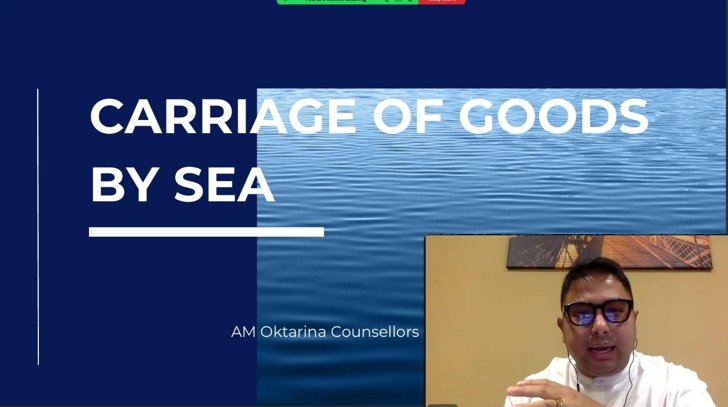
AM Oktarina Counsellors at Law’s Participation in ET-Asia Webinar on Carriage of Goods by Sea: Understanding Bills of Lading and Key International Rules
Contributors : Pramudya Yudhatama, S.H., C.L.A., Khaifa Muna Noer Uh’dina, S.H., and Ryan Mahadi Christian, S.H.
Reviewer : Noverizky Tri Putra Pasaribu, S.H., LL.M. (Adv.) Febrianda Pasaribu, M.Sc
On Monday, September 22th 2025, AM Oktarina Counsellors at Law (“AMO”) had the opportunity to contribute to the ET-Asia Webinar “Carriage of Goods by Sea: Understanding Bills of Lading and Key International Rules”. The webinar featured Mr. Noverizky Tri Putra Pasaribu, S.H., LL.M. (Adv.), Managing Partner of AMO, who delivered insights on the Carriage of Goods by Sea, a subject central to the dynamics of international maritime commerce. With his academic background from Leiden University and his recognized expertise in commercial and maritime law, Mr. Noverizky presented a thorough analysis of the contractual foundations, regulatory developments, and practical realities that define the carriage of goods by sea, both under global conventions and Indonesia’s domestic framework.
Carriage of Goods by Sea, as understood under international law, refers to a contract for the transportation of goods by sea, evidenced by a Bill of Lading (“B/L”). This contract covers the period beginning when the goods come under the control of the carrier until their discharge at the port of destination. Within the Indonesian legal framework, the concept is similarly defined but regulated more specifically under the Indonesian Commercial Code / Kitab Undang-
Undang Hukum Perdata (“KUHD”), Law No. 17 of 2008 on Shipping jo. Law No. 66 of 2024. Here, Carriage of Goods by Sea is characterized as an agreement in which the carrier undertakes the obligation to transport goods from the port of loading to the port of destination safely and in accordance with statutory requirements.
The allocation of responsibilities in this contractual relationship rests on both the shipper and the carrier. The shipper is expected to deliver goods in a condition suitable for transport, tailored to their nature and characteristics. Equally, the shipper must provide complete and accurate information regarding the cargo, particularly in cases involving hazardous or specialized goods, and ensure that the goods are packaged securely to prevent damage during the voyage. The shipper also carries the obligation to pay freight charges as agreed in the contract of carriage and to comply with all applicable legal and regulatory requirements at both the national and international levels.
At the heart of carriage of goods by sea lies the Bill of Lading / Konosemen (“Konosemen”), a document that has been universally recognized as central to maritime trade. As Mr. Noverizky explained, the Bill of Lading performs three principal functions. First, it acts as a receipt of goods, issued by the carrier to acknowledge the quantity and condition of cargo received. Second, it serves as evidence of the rights of the good’s owner, providing the legal ownership of the goods, so the right owner could divert the goods if needed. Third, and most distinctively, it functions as evidence of the contract of carriage, outlining the rights and obligations of both carrier and cargo owner. These functions underpin the B/L’s critical role in international trade, where documents often move faster than ships and facilitate commercial certainty across borders.
In practice, various types of B/L exist, each suited to commercial arrangements. A straight bill of lading is non-transferable and consigns goods to a named consignee. An order bill of lading is negotiable and transferable by endorsement, making it particularly important in financing and trade transactions. A bearer bill of lading allows delivery to whoever presents the document, offering flexibility but also greater risk. Understanding the distinctions between these forms is essential, as they determine how ownership and risk in the goods can be transferred and enforced.
The classification of Bills of Lading may also be viewed from several perspectives. Based on the status of the cargo, a Shipped Bill of Lading indicates that the goods have already been loaded on board and serves as strong evidence of shipment, while a Received for Shipment Bill of Lading shows that the goods have been received by the carrier but not yet loaded, functioning as proof of initial receipt. From the perspective of the condition of goods, a Clean Bill of Lading confirms that the goods were received in apparent good order and condition, and it is often required in transactions involving a Letter of Credit. Conversely, a Foul Bill of Lading includes notations that record damage or discrepancies in the cargo.
Further, Bills of Lading are distinguished by their negotiability. A Straight Bill of Lading is issued to a specific consignee and is non-negotiable, while an Order Bill of Lading is negotiable and may be transferred by endorsement, making it especially valuable in international trade where goods are frequently bought and sold while in transit. A Bearer Bill of Lading, by contrast, may be transferred simply by delivery of the document itself, without the need for endorsement. Lastly, from the standpoint of the method of transport, a Through Bill of Lading covers carriage involving more than one vessel or mode of transport, a Multimodal or Combined Transport Bill of Lading extends coverage to carriage by sea together with other modes such as land or air, and a Charter Party Bill of Lading is issued in the context of a charter party agreement for the hire of a vessel.
To regulate the responsibilities of carriers and the rights of cargo owners, the international community has established several conventions over the past century. The earliest and most influential are the Hague Rules of 1924, later updated through the Hague-Visby Rules of 1968, which impose minimum obligations on carriers. These rules require carriers to exercise due diligence to make vessels seaworthy, properly manned, and equipped, but they also allow significant exemptions from liability. As a result, the Hague and Hague-Visby frameworks have often been criticized for favoring carriers at the expense of cargo owners, though they remain widely adopted due to the legal certainty they provide.
In response to these criticisms, the Hamburg Rules of 1978 were developed, shifting the balance in favor of cargo interests. They expanded carrier liability, lengthened limitation periods, and restricted the scope of exemptions. However, despite their more equitable approach, the Hamburg Rules saw limited adoption, with many major maritime nations preferring the predictability of Hague-Visby. To address modern shipping realities, the Rotterdam Rules of 2008 introduced a more comprehensive regime that covers multimodal transport, electronic documentation, and contemporary risks. Yet, despite their ambition, the Rotterdam Rules have struggled to achieve global ratification, leaving a fragmented system in place.
As Mr. Noverizky observed, the differences between these regimes highlight the ongoing tension in maritime law. The Hague and Hague-Visby Rules provide stability but are often criticized as outdated and carrier friendly. The Hamburg Rules promote fairness for cargo owners but lack widespread acceptance. The Rotterdam Rules represent a forward-looking attempt to modernize maritime law, but their complexity and the reluctance of key states to ratify them have hindered their implementation. In practice, the governing law of a carriage contract is often determined less by theoretical fairness and more by the commercial bargaining power of the parties. This reality underscores the gap between the ideals of maritime law and the practicalities of international trade.
Indonesia, as a significant maritime nation, regulates carriage of goods by sea through a combination of the Commercial Code, Shipping Law No. 17 of 2008, and its amendments,
most recently under Law No. 66 of 2024. These provisions establish obligations for carriers and cargo owners, incorporate key international principles, and reflect Indonesia’s commitment to harmonizing domestic law with global standards. Nonetheless, challenges remain in interpretation and enforcement, particularly when disputes involve crossborder transactions and conflicting jurisdictions.
In his closing reflections, Mr. Noverizky emphasized that regulations on the carriage of goods by sea are fundamentally aimed at protecting the rights and responsibilities of both carriers and cargo owners. Yet, differing interpretations across jurisdictions continue to create legal uncertainty. Each international rule brings advantages and limitations, such as, the Hague Rules secure predictability for carriers but are seen as less favorable to shippers, while the Hamburg Rules are more protective of cargo owners but lack global acceptance. The Rotterdam Rules aspire to unify and modernize the regime but remain aspirational considering limited ratifications. In the reality of global trade, the applicable law is often determined not by what is most equitable but by the outcome of contractual negotiations and the relative bargaining strength of the parties. This dynamic illustrates the enduring gap between the theoretical aspirations of maritime law and the practical demands of international commerce.
Ultimately, the study of carriage of goods by sea reveals both the sophistication and the challenges of maritime law. As Indonesia continues to position itself as a global maritime hub, aligning domestic regulations with international conventions while addressing practical enforcement challenges will remain essential. For legal practitioners and stakeholders alike, the Bill of Lading and the international rules governing carriage of goods by sea are not only legal instruments but also the foundation of certainty, accountability, and trust in global scale trade.
Presentation File : 4 Carriage of Goods by Sea.byAMO.19.09.2025
For further information, please contact:
– 081777912