
AM Oktarina Counsellors at Law’s Participation in ET-Asia Webinar on Marine Pollution from Shipping Activities: IMO Regulations, Prevention and Response, and the Protection of Biodiversity
Contributors : Pramudya Yudhatama, S.H., C.L.A., Hana Khairunisa, S.H., and Ryan Mahadi Christian, S.H.
Reviewer : Noverizky Tri Putra Pasaribu, S.H., LL.M. (Adv.) Febrianda Pasaribu, M.Sc
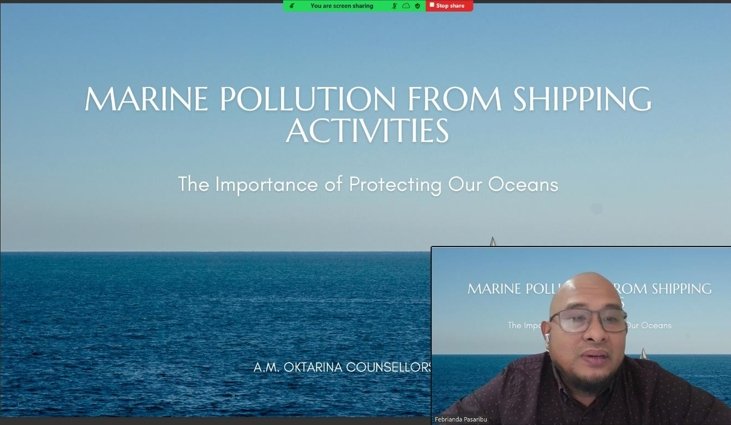
On Wednesday, September 24th, 2025, AM Oktarina Counsellors at Law (“AMO”) took part in the ET-Asia Webinar “Marine Pollution from Shipping Activities the Importance of Protecting Our Oceans.” The discussion placed emphasis on Indonesia’s evolving legal framework, particularly its efforts to reinforce maritime sovereignty while advancing pollution managing rules in the shipping sector. Representing AMO, Mr. Febrianda Pasaribu, M.Sc., Managing Partner, shared his expertise on the broader implications of these reforms for stakeholders in the maritime and logistics industries. With a strong academic foundation from Erasmus University and a rich professional experience in maritime law and policy, Mr. Febrianda offered an in-depth analysis of how international conventions and domestic legislation converge to tackle the pressing challenges of marine pollution and the protection of biodiversity.
Shipping always has been the backbone of global commerce for a long period of time, and for Indonesia, which is a vast archipelagic state with more than 17,000 islands—its importance cannot be overlooked. Nearly 90% of international trade relies on sea transport, and Indonesia
sits strategically along some of the busiest shipping lanes in the world. Yet, as Mr. Febrianda emphasized in a recent presentation, this reliance on maritime activities comes with significant risks. Most notably risk among them is marine pollution caused by shipping operations, a challenge that threatens not only Indonesia’s environment but also its long term maritime competitiveness.
Marine pollution from shipping manifests in many forms. Oil spills, whether caused by tanker accidents or illegal discharges remain one of the most visible and devastating threats, as illustrated by the 2018 oil spill in Balikpapan Bay. Beyond oil, ballast water discharged by ships introduces invasive species that disrupt local ecosystems, while exhaust emissions contribute to global problems such as air pollution and ocean acidification. Ships also generate solid and liquid waste, including sewage, plastics, and hazardous chemicals, while antifouling paints used to protect hulls often contain toxic substances like tributyltin. Mr. Febrianda noted that these pollutants are not isolated problems; rather, they represent a systemic risk that must be addressed through international cooperation, strong national regulation, and industry compliance.
From a legal perspective, the framework for preventing marine pollution is extensive. International conventions such as the United Nations Convention on the Law of the Sea (“UNCLOS 1982”), the International Convention for the Prevention of Pollution from Ships (“MARPOL”), and the Ballast Water Management Convention 2004 create a robust set of obligations for states and ship operators. MARPOL, for example, addresses oil, harmful liquid substances, dangerous packaged goods, sewage, garbage, and air emissions through its six annexes. Its core principles, including the precautionary principle, the polluter pays principle, and the responsibilities of flag and port states remain foundational to global shipping regulation. Mr. Febrianda highlighted that these principles establish accountability across the shipping chain, ensuring that those who profit from maritime commerce also bear responsibility for its environmental consequences.
Indonesia has formally embraced these global standards by ratifying key conventions, but it also maintains its own national legal instruments. Laws such as Law No. 17 of 2008 on Shipping, Law No. 32 of 2009 on Environmental Protection and Management (as amended), and most recently Law No. 66 of 2024, underline the country’s commitment to aligning domestic rules with international obligations. Complementary government regulations and ministerial decrees address issues ranging from waste discharge to port reception facilities. Together, these laws seek to prevent pollution, mandate emergency preparedness, and impose liability on shipowners for damages caused by their operations. Still, as Mr. Febrianda observed, enforcement remains uneven, and gaps in monitoring and compliance create vulnerabilities that undermine the effectiveness of even the most sophisticated regulatory structures.
Central to the enforcement of maritime pollution rules are the dual mechanisms of Flag State Control (“FSC”) and Port State Control (“PSC”). Under FSC, the flag state—the country where a ship is registered—bears responsibility for ensuring compliance with MARPOL and other conventions. Ships cannot operate without the necessary pollution prevention certificates issued by their flag state. However, many operators register vessels under so called “flags of convenience,” often in jurisdictions with weak oversight, which limits FSC’s effectiveness. By contrast, PSC empowers port states like Indonesia to inspect foreign vessels visiting their harbours, verify compliance, and even detain ships found in violation. Indonesia participates in regional cooperation frameworks such as the Tokyo Memorandum of Understanding to strengthen PSC, a step that Mr. Febrianda praised as crucial for protecting Indonesia’s waters from non-compliant foreign vessels.
Pollution prevention is only half the battle. Response mechanisms are equally critical. International frameworks such as the Oil Pollution Preparedness, Response, and Cooperation Convention (“OPRC 1990”) and the Civil Liability Convention (“CLC 1969”) establish requirements for oil spill emergency plans, international cooperation, and liability for compensation. Domestically, Indonesia has set out detailed procedures through ministerial regulations and coordination protocols involving agencies such as the Ministry of Transportation and the National Disaster Management Agency / Badan Nasional Penanggulangan Bencana (“BNPB”). These ensure that when spills or discharges occur, they are addressed swiftly and victims, including coastal communities and fishermen are entitled to compensation. According to Mr. Febrianda, effective response measures must balance responsibility, liability, and cooperation, ensuring that polluters are held accountable while also mobilizing collective resources for mitigation.
Marine pollution does not only present regulatory challenges—it poses direct threats to biodiversity and marine life. Oil spills devastate coral reefs and mangrove forests, ballast water spreads alien species that outcompete native fish, plastics entangle turtles and seabirds, and chemical discharges affect plankton at the base of the food chain. Emissions such as sulphur oxides and nitrogen oxides accelerate ocean acidification, threatening the long term survival of coral ecosystems. As Mr. Febrianda underlined, these impacts are not abstract environmental issues; they carry profound economic consequences by undermining fisheries, tourism, and the broader sustainability of Indonesia’s blue economy. For this reason, Indonesia’s laws on biodiversity protection, including Law No. 32 of 2024 on Conservation of Natural Resources are essential companions to maritime regulation.
Yet even with this extensive legal and policy framework, challenges persist. Implementation gaps, overlapping authorities, and limited port facilities hinder Indonesia’s ability to fully comply with international standards. As Mr. Febrianda pointed out, the reliance on economic trade-offs often complicates matters stricter environmental enforcement can increase operational costs for shipping companies, while leniency risks long term ecological damage. This tension between economic and environmental priorities is not unique to Indonesia, but it
is particularly acute for an archipelagic nation whose prosperity depends on both maritime commerce and healthy seas.
Looking forward, the path to cleaner and safer shipping in Indonesia requires a multilevel approach. International conventions provide the baseline, but strong domestic implementation and regional cooperation are essential. Investments in port infrastructure, pollution monitoring technologies, and capacity building for enforcement agencies must complement the legal framework. Industry stakeholders, too, must embrace a culture of compliance and corporate responsibility, recognizing that protecting the ocean is not just a regulatory burden but a shared moral obligation to future generations. As Mr. Febrianda concluded, laws and conventions are only as effective as their enforcement and the commitment of all actors involved.
To summarize, marine pollution from shipping activities remains one of the defining challenges of maritime governance in Indonesia. It is a problem that spans borders, implicates global trade, and tests the balance between economic growth and ecological stewardship. By engaging deeply with these issues and contributing thought leadership in forums such as the ET-Asia Webinar, AMO demonstrates its commitment to shaping a legal and policy framework that safeguards Indonesia’s maritime future. As Mr. Febrianda consistently emphasizes, protecting our oceans is not merely a legal requirement, it is a responsibility that underpins the resilience of Indonesia’s maritime identity and its role in the global economy.
Presentation File : 6 Marine Pollutions from Shipping Activites.byAMO.01.09.2025
For further information, please contact:
– 081777912