
AM Oktarina Counsellors at Law’s Participation in ET-Asia Webinar on Understanding Marine Insurance: Key Principles, Claims, and Subrogation
Contributors : Pramudya Yudhatama, S.H., C.L.A. and Ryan Mahadi Christian, S.H.
Reviewer : Noverizky Tri Putra Pasaribu, S.H., LL.M. (Adv.) Febrianda Pasaribu, M.Sc
On Friday, September 19th, 2025, AM Oktarina Counsellors a t Law (“AMO”) had the honor of participating in the ET-Asia Webinar “Understanding Marine Insurance: Key Principles, Claims, and Subrogation.” The event explores Indonesia’s evolving maritime framework and its implications for industry stakeholders. A key focus of the session was the transformative provisions of Law No. 66 of 2024 on Shipping, which amends the landmark Shipping Law No.
17 of 2008. This legislation reflects Indonesia’s determination to reinforce maritime sovereignty while promoting efficiency, safety, and investment across the shipping sector.
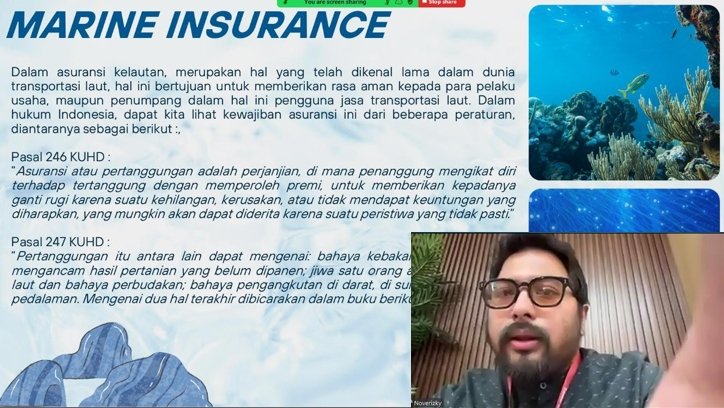
Representing AMO, Mr. Noverizky Tri Putra Pasaribu, S.H., LL.M. (Adv.), Managing Partner of the firm, delivered expert insights on the subject of marine insurance, highlighting its dual role as both a commercial safeguard and a statutory obligation in maritime operations. With academic training from Leiden University and recognition from leading international institutions, Mr. Noverizky has established himself as a trusted authority in commercial, corporate, and maritime law. Drawing on both transactional experience and policy perspectives, he provided a comprehensive analysis of marine insurance, focusing on its
fundamental principles, the mechanics of claims, and the doctrine of subrogation, while also addressing the broader implications of Indonesia’s shipping reforms for stakeholders across the maritime and logistics ecosystem.
One of the central themes highlighted during the webinar was the evolving role of marine insurance in Indonesia’s shipping industry. Historically, the Indonesian Commercial Code / Kitab Undang-Undang Hukum Dagang (“KUHD”) provided the earliest foundation for insurance regulation. Article 246 defines insurance as a contract under which the insurer, in exchange for premiums, promises to compensate the insured for loss, damage, or failure to obtain expected profits caused by uncertain events. Article 247 expands the scope of insurable risks to include fire, agriculture, maritime perils, life insurance, risks of slavery, and transportation by land, river, and inland waters. Over time, this framework has been broadened through more contemporary legislation. Law No. 4 of 2023, for instance, defines insurable interests expansively, encompassing not only goods and vessels but also human life, health, services, and liabilities. These developments demonstrate that insurance is increasingly understood not just as a financial safeguard but also as a comprehensive mechanism of risk management.
In the maritime sector specifically, Law No. 17 of 2008 on Shipping introduced express insurance obligations. Article 54 requires transport operators to insure their liabilities, while Article 203 obliges shipowners to insure their vessels. Liability for marine pollution is further mandated, and this requirement is clarified in Law No. 66 of 2024, which introduces several new obligations, including the explicit requirement of wreck removal insurance. This must be undertaken through domestic insurers or foreign insurers operating via representative offices in Indonesia, with the added condition that foreign insurers must establish joint ventures with domestic companies. As emphasized by Mr. Noverizky during the session, this amendment reflects a deliberate policy choice by the government to strengthen national capacity in the marine insurance sector while maintaining channels for international collaboration.
Marine insurance today thus plays a dual role: as a commercial instrument to mitigate risks and as a legal obligation embedded within Indonesia’s regulatory framework. Despite the strength of the legal architecture, however, practical challenges remain in its implementation. Compliance gaps are particularly evident among smaller operators, many of whom lack the financial capacity or regulatory awareness to meet mandatory insurance requirements. This creates systemic vulnerabilities that can undermine industry resilience. Claims handling also remains a persistent issue, with delays, disputes over coverage, and inconsistent documentation frustrating insured parties and weakening trust between insurers and clients. While the joint venture requirement under Law No. 66 of 2024 is intended to empower domestic insurers, it also raises short-term concerns, as local institutions may lack sufficient underwriting capacity to handle catastrophic, high-value claims. This creates a delicate balancing act: safeguarding national interests without compromising adequate coverage for stakeholders.
Beyond the obligations imposed under the Shipping Law, the government has reinforced its approach through broader policy directives. Presidential Instruction No. 5 of 2025 underscores the state’s commitment to strengthening the resilience of the maritime insurance sector by mandating greater involvement of domestic insurers, encouraging collaboration with international partners, and expanding national capacity to manage complex maritime risks. These measures are designed not only to ensure national participation but also to build a competitive and credible insurance market aligned with Indonesia’s position as a global maritime hub.
The principles of marine insurance also resonate with long-standing global legal traditions, particularly the Marine Insurance Act 1906. This seminal legislation has shaped global understanding of concepts such as insurable interest, utmost good faith, warranties, and indemnity. Although originating from the United Kingdom, the Act continues to serve as a reference point for global insurance practices, including those in Indonesia. Its doctrines, especially those on the duty of disclosure and indemnity, remain central to the interpretation and enforcement of marine insurance contracts, thereby bridging Indonesia’s domestic framework with international standards.
To ensure uniformity and clarity in practice, Indonesia has also adopted standardized forms such as the Indonesian Standard Marine Cargo Insurance Policy / Polis Standar Asuransi Pengangkutan Barang Indonesia (“PSAPBI”) for cargo insurance and the Standard Indonesian Hull Form – 1.10.70 for vessel coverage. These standardized policies establish clear benchmarks for coverage, exclusions, and claims procedures, reducing ambiguity and minimizing disputes between insurers and insured parties. In practice, marine insurance in Indonesia now covers a wide range of risks beyond traditional Hull & Machinery and Protection & Indemnity coverage, extending to cargo insurance, freight insurance, liability coverage, and specialized forms such as war risk and pollution insurance. This breadth allows stakeholders to adopt comprehensive strategies that balance risk transfer with operational efficiency.
Equally crucial are claims and subrogation mechanisms, which ensure the practical application of insurance contracts. The settlement of claims demands precision, transparency, and adherence to procedures, as any mismanagement risks creating confusion or financial loss. Subrogation, meanwhile, allows insurers who have compensated insured parties to pursue recovery from liable third parties, reinforcing fairness and accountability in maritime commerce. Properly understood and implemented, these mechanisms ensure that insurance remains an instrument of risk management rather than a source of disputes.
Taken together, these provisions demonstrate that marine insurance in Indonesia is more than a contractual safeguard, it is a cornerstone of maritime governance and commercial stability. By integrating provisions from the Commercial Code, Shipping Law, Presidential Instructions, and international legal traditions, Indonesia has built a comprehensive system that not only
enforces compliance but also supports broader objectives of maritime development. The challenge now lies in ensuring effective implementation and expanding the capacity of domestic insurers to address increasingly complex risks.
AMO’s participation in the ET-Asia webinar reflects the firm’s deep commitment to legal and policy leadership in maritime and logistics law. The firm recognizes that navigating complex reforms requires not only technical expertise but also strategic foresight, cross sector collaboration, and an inclusive approach that balances investor interests with national priorities. Through active involvement in academic, professional, and policy oriented forums, AMO contributes to building a more resilient, transparent, and progressive legal framework for Indonesia’s maritime sector. In doing so, the firm advances its broader vision of supporting national development and enhancing Indonesia’s position in the global maritime economy.
Finally, AMO expressed its gratitude to ET-Asia for organizing such an impactful event and for granting Mr. Noverizky the opportunity to serve as a keynote speaker. The firm also acknowledged the valuable contributions of Mr. Febrianda Pasaribu, M.Sc., whose insights underscored the importance of collaboration in advancing maritime law and policy. This engagement not only highlights AMO’s leadership in maritime and logistics law but also demonstrates its commitment to contributing beyond the courtroom by participating in broader policy dialogues and fostering industry-wide progress. Ultimately, the reforms under Law No. 66 of 2024 represent more than a technical amendment to the shipping framework. They signal Indonesia’s evolving maritime identity and its ambition to align domestic regulation with international standards while protecting national interests. As emphasized during the webinar, marine insurance is not merely a contract of financial protection; it is a cornerstone of certainty, accountability, and resilience in Indonesia’s maritime future. Through continued dialogue, collaboration, and policy engagement, AMO remains committed to ensuring that Indonesia’s maritime sector grows on a foundation of strong law, sound policy, and shared responsibility.
Presentation file : 3 MARINE_INSURANCE.byAMO.19.09.2025
For further information, please contact:
– 081777912