
Contributors : Pramudya Yudhatama, S.H., C.L.A., and Anis Sambuaga Telaumbanua, S.H.
Reviewer : Noverizky Tri Putra Pasaribu, S.H., LL.M. (Adv.) Febrianda Pasaribu, M.Sc
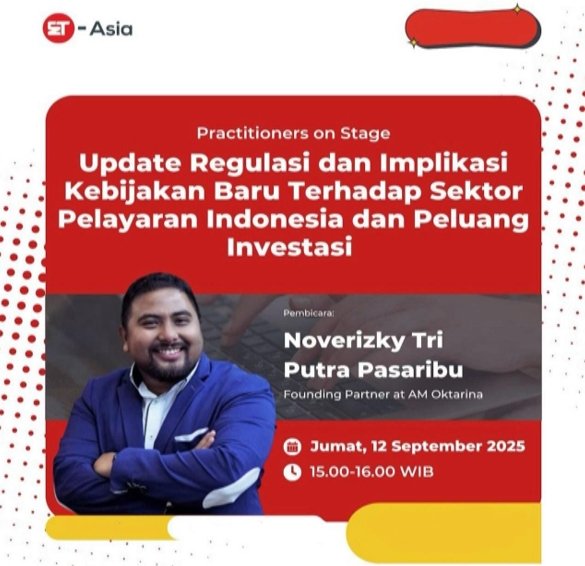
On Friday, September 12th 2025, AM Oktarina Counsellors at Law (“AMO”) had the honor of participating in the ET Asia Webinar titled “Pembaruan Regulasi dan Kebijakan Pelayaran: Implikasi Strategis bagi Investasi di Indonesia” (“Regulatory and Policy Updates in Shipping: Strategic Implications for Investment in Indonesia”).
The event served as a timely platform to discuss the transformative changes introduced under Law No. 66 of 2024 on Shipping, which amends the previous Shipping Law No. 17 of 2008. It brought together stakeholders across the maritime sector, including legal practitioners, shipping companies, investors, and policymakers, to explore both opportunities and challenges in navigating Indonesia’s evolving maritime legal landscape.
The session was led by Mr. Noverizky Tri Putra Pasaribu, S.H., LL.M. (Adv.), Managing Partner of AM Oktarina Counsellors at Law. With extensive academic training in international and European business law (Leiden University) and professional recognition from leading
global institutions, Mr. Noverizky is regarded as a future star in commercial, corporate, and maritime law. His experience in handling high level transactions and policy discussions uniquely positioned him to provide comprehensive insights into the reforms.
In addition, Mr. Febrianda Pasaribu, M.Sc., also joined the session and contributed valuable explanations and perspectives, particularly in relation to the practical and economic implications of the new shipping framework. His input enriched the discussion and provided the audience with a broader understanding of the reforms from both a legal and policy analysis standpoint.
Indonesia, as an archipelagic state with more than 17,000 islands, relies heavily on maritime transport approximately 90% of its trade is conducted via sea routes. Recognizing this strategic importance, the government enacted Law No. 66 of 2024 as the third amendment to the Shipping Law. The legislation aims to strengthen maritime sovereignty, enhance safety and efficiency, empower small scale shipping, and attract greater investment into the sector.
One of the most notable amendments introduced by Law No. 66 of 2024 is the reinforcement of the Cabotage Principle. The law unequivocally reaffirms that majority ownership in shipping companies must remain in the hands of Indonesian entities. While joint ventures with foreign investors are still permitted, the conditions have become considerably more stringent. Indonesian shareholders are required to hold a controlling interest, vessels deployed under such arrangements must have a minimum gross tonnage of 50,000, and all crew members must be Indonesian nationals. This legal framework seeks to preserve national control over domestic sea transportation while selectively opening limited avenues for foreign capital and technology transfer.
Another key development lies in the empowerment of local or traditional shipping operators (“pelayaran rakyat”). Newly inserted provisions under Articles 15A to 15E impose a positive obligation on the Government to provide structural support to this sector. The forms of support include capacity building programs, infrastructure development, targeted financing schemes, and state subsidies. This initiative aims not only to safeguard Indonesia’s cultural maritime heritage but also to enhance inter island connectivity, particularly in underserved regions, while simultaneously stimulating local economic development.
The legislation further codifies the mandatory nature of pioneer shipping services. Unlike the previous regime, where pioneer routes were largely considered a matter of discretionary policy, the State is now legally mandated to ensure the provision of shipping services to underdeveloped, frontier, and outermost the so called ‘3T’ regions in Indonesia (terdepan, tertinggal, and terluar). Such services are expressly recognized as a public obligation, with financial support sourced from both central and regional government budgets.
Significant changes are also made in the area of port governance and tariff regulation. The nomenclature of port authorities has been standardized to “Otoritas Penyelenggara Pelabuhan,” thereby harmonizing administrative structures across the archipelago. Tariff setting mechanisms have been clarified, requiring a higher degree of transparency, accountability, and government oversight where necessary. Moreover, stevedoring operators are legally required to establish partnerships with local micro, small, and medium sized
enterprises (“UMKM”), thereby ensuring inclusivity and promoting fair competition within port activities.
With respect to safety and judicial oversight, maritime safety supervision has been expanded to encompass security and environmental protection. The Maritime Court (“Mahkamah Pelayaran”) has been elevated to a permanent judicial institution with extended jurisdiction, including the authority to summon shipowners in addition to captains and crew members. Sanctions against foreign vessels breaching Indonesian maritime zones have also been significantly strengthened, with penalties now extending up to 11 years of imprisonment and fines of up to IDR 5 billion. These measures are intended to fortify maritime sovereignty and align Indonesia with international best practices in maritime safety and enforcement.
Finally, the law introduces enhanced financing mechanisms and fiscal incentives. Government support is no longer confined to tax relief; it now encompasses broader financing schemes and the possibility of long term contractual partnerships between shipowners and cargo owners. These measures are designed to reduce investment risks, accelerate fleet modernization, and increase the overall efficiency of Indonesia’s national logistics system.
Mr. Noverizky emphasized that the reforms strike a balance between protecting national interests and attracting investment. By reinforcing the cabotage principle, Indonesia safeguards its maritime sovereignty, while selective joint ventures allow foreign expertise and capital to enter the market under strict safeguards.
At the same time, the law introduces inclusivity measures by empowering pelayaran rakyat and UMKM, ensuring that smaller players remain part of the maritime ecosystem. However, the requirement for vessels of GT 50,000 in joint ventures presents significant barriers to entry for medium sized companies, highlighting the need for tailored financing solutions.
Mr. Noverizky also underlined several transitional challenges arising from the enactment of Law No. 66 of 2024. First, compliance with the newly established tariff governance framework is expected to increase logistics costs and may necessitate the renegotiation of existing contractual arrangements. Second, the requirement to upgrade safety standards and adopt modern technologies will inevitably demand substantial capital investment, which could pose a considerable burden, particularly for small and medium sized operators. Third, the statutory timeline for transition most notably the minimum gross tonnage (GT 50,000) requirement for joint ventures, which will come into effect in October 2025 is regarded as insufficient by many domestic shipping companies, thereby creating the risk of non compliance and market disruption if not accompanied by adequate governmental support and industry preparedness.
Despite these hurdles, the law is expected to enhance investor confidence by providing greater legal certainty, structured incentives, and long term stability in Indonesia’s maritime sector.
For AMO, participation in this webinar underscores our dedication to remaining at the forefront of legal and policy developments in critical industries such as maritime and logistics. We believe that navigating complex legal reforms requires not only technical expertise but also strategic foresight, cross sector collaboration, and a commitment to inclusive growth.
Through continuous engagement in academic, professional, and policy oriented forums, AMO seeks to contribute to building a more resilient, transparent, and progressive legal framework for Indonesia’s maritime sector.
We extend our sincere gratitude to ET Asia for organizing this impactful event and for granting the extraordinary opportunity to entrust Mr. Noverizky Tri Putra Pasaribu, S.H., LL.M. (Adv.) with the role of speaker, as well as to Mr. Febrianda Pasaribu, M.Sc. for his insightful contributions, both of whom shared their expertise with the wider community.
For further information, please contact:
– 081777912