
Contributors : Pramudya Yudhatama, S.H., C.LA., Khaifa Muna Noer Uh’dina, S.H., and Anis Sambuaga Telaumbanua, S.H.
Reviewer : Noverizky Tri Putra Pasaribu S.H. LL.M. (Adv.) and Febrianda
Pasaribu, M.Sc
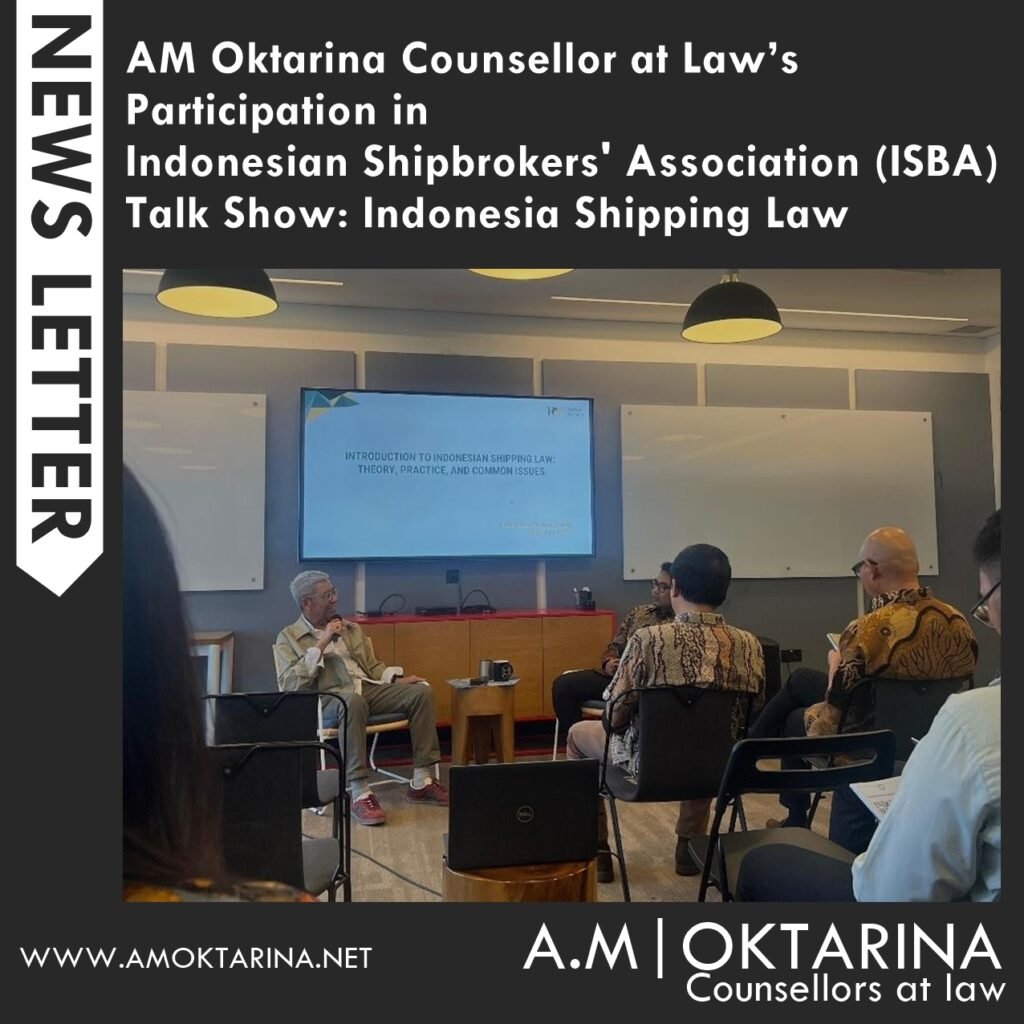
On Thursday, July 31st, 2025, AM Oktarina Counsellor at Law (“AMO”) had the opportunity to participate in a talk show entitled “(ISBA) Talk Show: Indonesia Shipping Law” organized as part of the Indonesian Shipbrokers Association (“ISBA”) located at 29D Classroom, WeWork Noble House, 30th floor, Mega Kuningan No. 2, Jl. Dr. Ide Anak Agung Gde Agung Kav. E 4.2, Jakarta 12950. The event aimed to enhance understanding of Indonesian shipping law while fostering dialogue among legal practitioners and key stakeholders in the shipping and logistics industry.
ISBA is a professional association engaged in shipbroking, which involves acting as an intermediary in the sale, purchase, and chartering of vessels within the maritime sector. One of the partners at AMO, Febrianda Pasaribu, M.Sc, is an active member of ISBA and contributes to the ongoing development of the shipbroking industry in Indonesia.
Our firm was represented by Pramudya Yudhatama, S.H., C.L.A. and Khaifa Muna Noer Uh’dina, S.H. Their attendance underscored our firm’s commitment to continuously enhance human capital through participation in professional development forums, and to actively engage in strategic discussions regarding reforms in the maritime and transportation legal sectors.
Indonesian shipping law is fundamentally divided into two major branches: wet shipping and dry shipping. Wet shipping concerns maritime incidents that occur during the operation of a vessel, including collisions, pollution, salvage operations, and wreck removal. Dry shipping, in contrast, covers contractual and documentary matters, such as the issuance and enforcement of bills of lading, charter party agreements, ship financing, and vessel registration. Together, these two branches form the foundation of maritime law practice in Indonesia.
The legal framework governing Indonesian shipping activities is drawn from multiple sources. These include the Indonesian Commercial Code (Kitab Undang-Undang Hukum Dagang or KUHD), Law No. 17 of 2008 on Shipping, as last amended by Law No. 66 of 2024, and a variety of ministerial and governmental regulations, such as the Minister of Transportation Regulation No. 39 of 2017 on Vessel Registration and Nationality and Minister of Transportation Regulation No. 2 of 2021 on the Use of Foreign Vessels. In addition, Indonesia refers to several key international conventions, although not all are ratified. These include the International Convention for the Safety of Life at Sea 1974 (SOLAS), the Convention on the International Regulations for Preventing Collisions at Sea 1972 (COLREG), the Maritime Labour Convention 2006 (MLC), and the Nairobi International Convention on the Removal of Wrecks 1982.
Within the dry shipping domain, the bill of lading plays a central role. Recognised as a valid contract of carriage by Supreme Court Decision No. 716 K/Pdt/1984, the bill of lading is regulated under Articles 505 to 510 of the Indonesian Commercial Code. This document serves as written evidence that the carrier has received specific cargo with the intention to transport and deliver it to a named consignee under agreed terms. It may be issued by the master of the vessel or another authorised party, and the lawful holder of the bill retains the right to sue. The carriage of goods by sea typically involves several actors: the carrier (usually the shipowner or operator), the shipper (who initiates shipment), the consignee (the party entitled to receive the goods), the notify party (often a customs broker or forwarder), and the freight forwarder who facilitates cargo movement. The master, as the legal representative of the shipowner, is responsible for the safe operation and navigation of the vessel.
Charter party agreements are categorised into three main types under Indonesian law: voyage charters, time charters, and bareboat or demise charters. In a voyage charter, the vessel is hired for a specific journey, and the shipowner remains responsible for crewing, navigation, and operation. In a time charter, the vessel is leased for a defined period, but control over navigation and maintenance generally remains with the owner. Under a bareboat charter, the charterer assumes full responsibility, including crewing and operating the vessel, effectively taking on the role of the shipowner for the charter duration.
Ship registration in Indonesia is subject to strict eligibility requirements. Only vessels of at least 7 (seven) gross tonnage (“GT”) may be registered, and ownership is restricted to Indonesian citizens, Indonesian legal entities, or joint ventures in which Indonesian parties hold
at least 51 percent of the shares. Indonesia employs a closed registry system, meaning dual registration of Indonesian flagged vessels in foreign jurisdictions is prohibited. Owners may select any designated port for registration, provided that they submit all required documentation, including the measurement certificate, proof of ownership (such as a bill of sale or notarial deed), the owner’s identity, and any necessary permits. Deletion of a vessel from the registry may occur due to total loss, foreign transfer, scrapping, piracy, or pursuant to a binding court decision.
Ship finance arrangements typically begin with a legal due diligence process, followed by the negotiation and execution of a sale and purchase agreement, most commonly using the Norwegian Sale Form (NSF) 2012. The buyer and seller then coordinate with financial institutions and complete the title transfer and registration procedures to perfect ownership and enable lawful operation of the vessel under Indonesian law.
In matters of wet shipping, liability for ship collisions is determined under Articles 534 to 537 of the Indonesian Commercial Code and supplemented by the Shipping Law. The degree of fault attributable to each vessel governs the apportionment of liability. Where the cause of collision is uncertain or attributable to force majeure, each party bears its own loss. If fault lies entirely with one vessel, that party bears full liability for damages. In cases of shared fault, damages are apportioned proportionally. Administrative sanctions arising from maritime accidents are regulated under Government Regulation No. 9 of 2019, ranging from warnings to suspension of seafarer certificates for up to twenty four months depending on the severity of the incident.
Limitation periods, or time bars, apply to maritime claims. Claims arising from collisions must be submitted within two years from the date of the incident, while cargo related claims must be filed within one year of delivery or the date on which delivery ought to have occurred. However, these time bars may be interrupted or suspended by the issuance of a formal notice (known as a sommatie), initiation of legal proceedings, or other judicial measures, pursuant to Article 1979 of the Indonesian Civil Code.
Maritime claims, as defined under Article 223 of the Shipping Law, include those for physical damage caused by ship operations, salvage services, pollution, charter party breaches, and loss of cargo, among others. To secure such claims, Indonesian law allows for ship arrest under Article 222 of the Shipping Law. However, practical challenges persist, such as the absence of a detailed court procedure for arrest orders and the judiciary’s general reluctance to issue arrest writs without a civil claim being filed. Moreover, the arrest of sister ships vessels under common ownership with the offending ship is not permitted under Indonesian practice.
In the event of wrecks, the shipowner or master has an obligation to report the incident and remove the wreck within 180 calendar days. This requirement is outlined under the Nairobi International Convention on the Removal of Wrecks 2007, which Indonesia ratified through Presidential Regulation No. 80 of 2020. For vessels of 35 GT or more, owners must procure wreck removal insurance or Protection and Indemnity (P&I) coverage, as stipulated by Minister of Transportation Regulation No. 71/2013, as amended by Minister of Transportation Regulation No. 27/2022.
Marine pollution carries strict liability under Indonesian law. The shipowner or operator is responsible for preventing and mitigating pollution. Non-compliance may lead to criminal
penalties of up to two years’ imprisonment and a fine of up to IDR 300 million. Furthermore, oil tankers carrying more than 2,000 tons of oil must maintain insurance or financial security in accordance with the 1992 International Convention on Civil Liability for Oil Pollution Damage (CLC), which requires either an insurance certificate or financial guarantee.
As for marine insurance, Indonesian maritime practice recognises several common types, including Protection and Indemnity (P&I) insurance, Hull and Machinery (H&M) insurance, and War Risk insurance. These insurances are facilitated by P&I clubs, where members (usually shipowners or charterers) are supported by brokers and local correspondents in the event of claims or incidents.
Finally, the Indonesian maritime sector is regulated and supervised by a number of public institutions. These include the Directorate General of Sea Transportation, the Maritime Tribunal (Mahkamah Pelayaran), the Indonesian Classification Bureau (Biro Klasifikasi Indonesia or BKI), the National Transportation Safety Committee (Komite Nasional Keselamatan Transportasi or KNKT), the Indonesian Navy and Marine Police, as well as international bodies such as the International Maritime Organization (IMO). Together, these institutions provide oversight, enforcement, and policy guidance to ensure maritime safety, environmental protection, and legal compliance within Indonesia’s territorial waters.
The presentations delivered by the speakers were thorough, practice based, and supported by critical analysis of the actual implementation of shipping law in Indonesia. The discussions in this seminar centered on shipping law and current issues related to the maritime sector, including various ongoing developments and practical realities at both national and international levels. All topics were thoroughly explored through interactive and reflective dialogue, highlighting the real world challenges faced by the shipping industry in an increasingly evolving global context.
For AMO, participation in this seminar was not merely an academic engagement but a strategic investment in strengthening our expertise particularly in navigating the complex legalities that govern the maritime and logistics sectors, which we regard as vital to both national and global economies. We firmly believe that high quality legal services can only be rendered by legal professionals who possess comprehensive understanding, contextual awareness, and a commitment to keeping abreast of the latest legal developments.
Moreover, the seminar served as a crucial avenue for professional networking, cross sectoral insight sharing, and deeper appreciation of the realities of maritime law from the perspectives of various stakeholders. Our participation in such events is a reflection of our firm’s work philosophy that excellence in legal services can only be achieved through continuous learning and openness to interdisciplinary approaches.
We extend our highest appreciation to the distinguished speakers for their generous knowledge sharing, and to the organizing committee for curating such a well structured, professional, and impactful seminar. The insights we gained will undoubtedly support not only the individual professional growth of our delegates but also serve as a foundational resource in developing adaptive, solution oriented, and justice centered legal approaches within the maritime sector.
Looking ahead, AMO remains committed to actively participating in various academic and professional forums both nationally and internationally as part of our ongoing contribution to the development of a more resilient, responsive, and progressive legal system. We believe that the advancement of maritime law is not the responsibility of a single actor, but a collaborative endeavor that must involve all elements within the legal and maritime ecosystems.
For further information, please call:
– N.pasaribu@ amokt arina. net
– 081777912