News & Legal Update

IMPLEMENTASI PERATURAN MENTERI HUKUM REPUBLIK INDONESIA NOMOR 50 TAHUN 2025 TENTANG LAYANAN APOSTILLE

Contributors : Pramudya Yudhatama, S.H., C.L.A., and Anis Sambuaga Telaumbanua, S.H. Reviewer : Noverizky Tri Putra Pasaribu, S.H., LL.M. (Adv.)   Background Meningkatnya mobilitas masyarakat lintas negara telah membawa implikasi hukum yang signifikan, khususnya dalam hal penggunaan dan pengakuan dokumen publik di yurisdiksi asing. Dalam praktiknya, kebutuhan akan legalisasi dokumen tidak hanya berkaitan dengan aspek administratif semata, tetapi juga menyentuh persoalan kepastian hukum, efisiensi pelayanan publik, serta daya saing negara dalam mendukung aktivitas pendidikan, ketenagakerjaan, dan bisnis internasional. Oleh karena itu, penyederhanaan mekanisme legalisasi dokumen menjadi isu penting yang memerlukan respons regulatif yang adaptif dan terstandar secara internasional.   Sebelumnya, Indonesia telah memiliki regulasi perihal Apostille ini, melalui Permenkumham 6/2022, namun selanjutnya, sebagai bentuk penyempurnaan pengaturan di tingkat nasional, Menteri Hukum kemudian menetapkan Permenkum 50/2025, yang sekaligus mencabut dan menggantikan Peraturan Menteri Hukum dan Hak Asasi Manusia Nomor 6 Tahun 2022 tentang Layanan Legalisasi Apostille karena dinilai sudah tidak sesuai lagi dengan perkembangan hukum dan kebutuhan masyarakat, sehingga perlu diganti. Hal ini tertera dalam bagian Menimbang poin a. Permenkum 50/2025. Lantas bagaimana pengaturan melalui Permenkum 50/2025, berikut adalah pembahasannya :   Legal Basis Peraturan Menteri Hukum Dan Hak Asasi Manusia Republik Indonesia Nomor 6 Tahun 2022 Tentang Layanan Legalisasi Apostille Pada Dokumen Publik (“Permenkumham 6/2022”) Peraturan Menteri Hukum Nomor 50 Tahun 2025 tentang Layanan Apostille (“Permenkum 50/2025”)   Dalam konteks pengaturan tersebut, perlu dipahami apa itu Apostille. Maka pengertiannya dapat kita temukan dalam bunyi ketentuan berikut :   “Legalisasi Apostille yang selanjutnya disebut Apostille adalah tindakan untuk mengesahkan kesesuaian tanda tangan Pejabat, pengesahan cap, dan/atau segel resmi dalam dokumen yang dimohonkan berdasarkan verifikasi.” (vide Pasal 1 ayat 1 Permenkum 50/2025)   Keberadaan Apostille sendiri memberikan jaminan bahwa dokumen yang bersangkutan benar-benar diterbitkan oleh pejabat yang berwenang, sehingga dapat diterima dan diakui oleh otoritas di negara tujuan tanpa memerlukan legalisasi tambahan. Permenkum 50/2025 juga secara rinci mengatur ruang lingkup dokumen publik yang dapat diajukan untuk memperoleh Apostille. Berikut adalah diantara dari dokumen yang diliputi oleh Permenkum 50/2025 :   “(2) Apostille sebagaimana dimaksud pada ayat (1) dilakukan terhadap Dokumen yang diterbitkan di wilayah Indonesia dan akan dipergunakan di wilayah negara lain yang menjadi negara peserta Konvensi. (3) Dokumen sebagaimana dimaksud pada ayat (2) meliputi: Dokumen yang berasal dari suatu otoritas atau Pejabat yang berkaitan dengan pengadilan atau tribunal negara, termasuk yang berasal dari penuntut umum, panitera pengadilan, atau jurusita; Dokumen administratif; Dokumen yang dikeluarkan oleh notaris; dan sertifikat resmi yang dilekatkan pada Dokumen yang ditandatangani oleh perseorangan dalam kewenangan perdatanya, seperti sertifikat yang mencatat pendaftaran suatu Dokumen, atau yang mencatat masa berlaku tertentu suatu Dokumen pada tanggal tertentu, dan pengesahan tanda tangan oleh Pejabat dan notaris.” (vide Pasal 2 ayat (2) dan (3) Permenkum 50/2025)   Namun demikian, lebih lanjut Pasal 2 ayat (4) Permenkum 50/2025 ini memberikan pengecualian terhadap jenis dokumen tertentu, seperti dokumen yang ditandatangani oleh pejabat diplomatik atau konsuler, dokumen administratif yang berkaitan langsung dengan kegiatan komersial atau kepabeanan, serta dokumen yang diterbitkan oleh kejaksaan sebagai lembaga penuntutan sebagaimana tercantum dalam Pasal 1 Perpres 2/2021 tentang Pengesahan Convention Abolishing the Requirement of Legalisation for Foreign Public Documents (Konvensi Penghapusan Persyaratan Legalisasi terhadap Dokumen Publik Asing).   Dari sisi prosedural, Permenkum 50/2025 menegaskan bahwa permohonan Apostille dilakukan oleh pemohon kepada Menteri melalui Direktorat Jenderal Administrasi Hukum Umum (“Dirjen AHU”) dan dilakukan secara elektronik. Permohonan yang disampaikan oleh pemohon dalam hal ini meliputi permohonan terhdap dokumen dan menghasilkan sertifikat Apostille yang dilekatkan dengan dokumen yang dimohonkan atau permohonan terhadap dokumen yang ditandatangani secara elektronik berdasarkan ketentuan peraturan perundang-undangan dan menghasilkan sertifikat e-Apostille yang dilekatkan secara elektronik dengan dokumen yang dimohonkan dan disampaikan secara elektronik kepada pemohon. Hal ini tertuang dalam Pasal 3 ayat (2) dan (3) Permenkum 50/2025.   Pemohon, diwajibkan mengisi formulir permohonan yang paling sedikit memuat identitas pemohon, identitas penerima kuasa jika permohonan diajukan melalui kuasa, negara tujuan penggunaan dokumen, jenis dokumen, nama dan nomor dokumen serta nama pemilik tertera pada dokumen yang akan di mohonkan Apostille, nama pejabat yang menandatangani, serta instansi penerbit dokumen. Selain itu, pemohon juga harus mengunggah dokumen pendukung berupa kartu identitas diri, kartu identitas kuasa dan surat kuasa apabila permohonan dikuasakan, serta dokumen yang akan dimohonkan Apostille. Ketentuan berikut, dapat kita temukan dalam Pasal 3 ayat (4) dan (5) Permenkum 50/2025.   Setelah permohonan diajukan, dilakukan proses verifikasi oleh Dirjen AHU dilakukan dalam jangka waktu paling lama 3 (tiga) hari kerja setelah permohonan dinyatakan lengkap. Verifikasi tersebut meliputi pencocokan data dalam formulir permohonan dengan dokumen pendukung, pemeriksaan kesesuaian nama Pejabat, jabatan, tanda tangan Pejabat, cap, dan/atau segel resmi pada Dokumen dengan spesimen yang tersimpan pada pangkalan data Dirjen AHU, serta pemeriksaan keabsahan tanda tangan elektronik untuk Dokumen elektronik. Ketentuan ini terdapat dalam Pasal 5 ayat (2) dan (3) Permenkum 50/2025.   Permohonan Apostille juga dapat ditolak apabila hasil verifikasi menunjukkan adanya ketidaksesuaian data baik antar dokumen, maupun data dengan pangkalan data Dirjen AHU, atau ketidakabsahan tanda tangan elektronik. Penolakan disampaikan secara elektronik disertai alasan penolakan. Ketentuan ini terdapat dalam Pasal 6 Permenkum 50/2025. Selain penolakan, sebelumnya permohonan juga dapat dikembalikan. Pengaturan atas hal ini terdapat pada Pasal 4 Permenkum 50/2025.     Namun, apabila permohonan dinyatakan memenuhi seluruh persyaratan, pemohon diwajibkan melakukan pembayaran biaya Apostille sesuai dengan ketentuan Penerimaan Negara Bukan Pajak (“PNBP”) yang berlaku dengan jangka waktu pembayaran paling lama 7 (tujuh) hari Kalender sejak pemberitahuan diterbitkan. Dalam hal pemohon tidak melakukan pembayaran sesuai dengan jangka waktu tersebut, maka surat perintah bayar tidak dapat digunakan untuk melakukan pembayaran. Dalam hal ini maka yang dapat dilakukan adalah mengajukan kembali permohonan Apostille. (vide Pasal 7 Permenkum 50/2025)   Namun, apabila pembayaran telah dilakukan, pemohon memperoleh pemberitahuan secara elektronik untuk pengambilan sertifikat Apostille. Pengambilan sertifikat Apostille dapat dilakukan setelah pembayaran tersebut. Pengambilan sertifikat Apostille dilakukan oleh pemohon atau oleh kuasa, jika dikuasakan dengan menunjukkan Dokumen yang dimohonkan Apostille di loket pelayanan Apostille pada kantor pusat atau kantor wilayah Kementerian Hukum. (vide Pasal 8 Permenkum 50/2025)   Pengambilan Apostille dilaksanakan paling lama 60 (enam puluh) hari kalender sejak pembayaran dilakukan. Apabila tidak diambil dalam jangka waktu yang ditentukan maka permohonan dan pembayaran dianggap hangus dan
IMPLEMENTASI PERATURAN MENTERI HUKUM REPUBLIK INDONESIA NOMOR 50 TAHUN 2025 TENTANG LAYANAN APOSTILLE Read More »

ANALISIS PERMENKUM 49/2025 TENTANG SYARAT DAN TATA CARA PENDIRIAN, PERUBAHAN, DAN PEMBUBARAN BADAN HUKUM PERSEROAN TERBATAS

Contributors : Pramudya Yudhatama, S.H., C.L.A., and Aqqhila Felia Putri, S.H. Reviewer : Noverizky Tri Putra Pasaribu, S.H., LL.M. (Adv.)   Background Dewasa ini, banyak Perseroan Terbatas (“PT”) di Indonesia mengalami tantangan tertib administrasi badan hukum. Semakin kompleksitas bidang usaha dan tantangan pasar, menjadikan tantangan lebih meluas. Tentunya, tantangan yang hadir untuk pelaku usaha yang memiliki PT, juga terdapat dari sisi aktivitas bisnis yang beririsan dengan regulasi yang berlaku. Maka, pertanyaan selanjutnya adalah bagaimana pelaku usaha jika ingin mendirikan, merubah, maupun membubarkan badan hukum PT? Kementerian Hukum, melalui Permenkum 49/2025 telah mengaturnya. Dimana ketentuan ini menggantikan keberlakuan Permenkumham 21/2021. Lantas bagaimana pengaturannya ? Mari simak penjelasan kami sebagai berikut.   Legal Basis Peraturan Menteri Hukum dan Hak Asasi Manusia Nomor 21 Tahun 2021 Syarat dan Tata Cara Pendaftaran Pendirian, Perubahan, dan Pembubaran Badan Hukum Perseroan Terbatas (“Permenkumham 21/2021”). Peraturan Menteri Hukum Nomor 49 Tahun 2025 tentang Syarat dan Tata Cara Pendirian, Perubahan, dan Pembubaran Badan Hukum Perseroan Terbatas (“Permenkum 49/2025”).   Sebelum lebih jauh, perlu kita ketahui terlebih dahulu apa yang dimaksud dengan SABH secara definisi mengacu kepada Pasal 1 angka 4 Permenkum 49/2025 yang berbunyi: “Sistem Administrasi Badan Hukum yang selanjutnya disingkat SABH adalah pelayanan jasa teknologi informasi Perseroan secara elektronik yang diselenggarakan oleh Direktorat Jenderal Administrasi Hukum Umum.” ​   Selanjutnya, dalam Permenkum 49/2025, mengatur terkait klasifikasi perseroan itu sendiri. Hal ini dapat tercermin melalui ketentuan pada Pasal 2 ayat (1) Permenkum 49/2025 yang menyatakan perseroan terdiri dari perseroan persekutuan modal dan perseroan perorangan. Poin selanjutnya, perlu diketahui maka permohonan untuk pendirian, perubahan, dan pembubaran badan hukum, diajukan kepada Menteri Hukum melalui Direktur Jenderal, yang dalam hal ini adalah Direktur Jenderal Administrasi Hukum Umum (“Dirjen AHU”). Ketentuan ini, dapat kita temukan di Pasal 3 Permenkum 49/2025.   Pada poin selanjutnya, dapat kita cermati di Bagian Kesatu. Dimana diatur untuk pendirian perseroan persekutuan modal. Dimana terdapat kelengkapan dokumen, yang diajukan melalui notaris, dengan mengisi formular pendirian secara elektrnik melalui SABH (vide Pasal 5 dan 6 ayat (1) Permenkum 49/2025). Tidak sampai di pendirian saja, selanjutnya dapat ditemui perihal perubahannya. Lingkup dari perubahan ini sendiri adalah anggaran dasar dan data. (vide Pasal 8 ayat (1) Permenkum 49/2025)   Secara lebih mendetail, dapat kita temukan klasifikasi perubahan anggaran dasar ini sendiri yang harus mendapatkan persetujuan Menteri. Berikut diantaranya : “a. nama Perseroan; tempat kedudukan Perseroan; maksud dan tujuan serta kegiatan usaha Perseroan; jangka waktu berdirinya Perseroan; besarnya modal dasar; pengurangan modal ditempatkan dan disetor; dan/atau status Perseroan yang tertutup menjadi Perseroan terbuka atau sebaliknya” (vide Pasal 8 ayat (3) Permenkum 49/2025)   Selain daripada anggaran dasar, perubahan juga dimungkinkan untuk data. Berikut merupakan bunyi ketentuan tersebut : “a. perubahan susunan pemegang saham karena pengalihan saham dan/atau perubahan jumlah kepemilikan saham yang dimiliki; perubahan susunan atau pengangkatan kembali nama dan jabatan anggota direksi dan/atau dewan komisaris; penggabungan, pengambilalihan, dan pemisahan yang tidak disertai perubahan anggaran dasar; pembubaran Perseroan; berakhirnya status badan hukum Perseroan; perubahan nama pemegang saham karena ganti nama; dan perubahan alamat lengkap Perseroan.” (vide Pasal 8 ayat (5) Permenkum 49/2025)   Melihat dari ketentuan diatas, tentunya dapat kita simpulkan, perubahan dimungkinkan untuk merubah anggaran dasar, maupun data perseroan. Tentunya disesuaikan dengan kebutuhan pelaku usaha. Lantas bagaimana mengatur notifiaksi dan penyampaian perubahannya? Hal ini dapat kita lihat di ketentuan selanjutnya.   Dapat kita jelaskan, perubahan anggaran dasar maupun data, ditetapkan melalui RUPS atau keputusan pemegang saham di luar RUPS yang mengikat. Perubahan ini, selanjutnya dinyatakan dalam akta notaris berbahasa Indonesia. (vide Pasal 9 ayat (1), dan (2) Permenkum 49/2025). Selanjutnya lebih mendetail terdapat ketentuan jangka waktu sebagai berikut :   “(3) Perubahan anggaran dasar yang tidak dimuat dalam akta berita acara rapat yang dibuat notaris harus dinyatakan dalam akta notaris dalam jangka waktu paling lama 30 (tiga puluh) Hari terhitung sejak tanggal keputusan RUPS. (4) Perubahan anggaran dasar tidak boleh dinyatakan dalam akta notaris setelah lewat jangka waktu 30 (tiga puluh) Hari sebagaimana dimaksud pada ayat (3). (5) Dalam hal terjadi perubahan data Perseroan berupa perubahan anggota direksi dan dewan komisaris, direksi wajib memberitahukan perubahan data Perseroan tersebut kepada Menteri melalui Direktur Jenderal untuk dicatat dalam daftar Perseroan dalam jangka waktu paling lama 30 (tiga puluh) Hari terhitung sejak tanggal perubahan tersebut. (6) Permohonan perubahan anggaran dasar dan/atau perubahan data Perseroan selain perubahan anggota direksi dan dewan komisaris sebagaimana dimaksud pada ayat (5) diajukan kepada Menteri melalui Direktur Jenderal dalam jangka waktu paling lama 30 (tiga puluh) Hari terhitung sejak tanggal akta notaris yang memuat perubahan anggaran dasar. (7) Dalam hal permohonan perubahan anggaran dasar dan/atau data Perseroan melewati jangka waktu sebagaimana dimaksud pada ayat (6), tidak dapat diajukan kepada Menteri.” (vide Pasal 9 ayat (3)-(7) Permenkum 49/2025)   Dalam pengajuan permohonan perubahan, juga diperlukan data pendukung lainya, yang terdiri dari : “a. notula RUPS perubahan anggaran dasar atau keputusan pemegang saham di luar RUPS; akta pemindahan hak atas saham; surat rekomendasi dari kementerian atau lembaga yang memberikan izin usaha; bukti pengumuman dalam 1 (satu) surat kabar; nomor pokok wajib pajak; bukti setor modal Perseroan dari bank atas nama Perseroan, neraca Perseroan tahun buku berjalan, atau bukti setor dalam bentuk lain; surat keterangan mengenai alamat lengkap Perseroan dari pengelola gedung atau instansi yang berwenang; penetapan atau keputusan ganti nama pemegang saham dari instansi yang berwenang; laporan keuangan tahunan; dan/atau j. dokumen Pemilik Manfaat Perseroan yang terdiri atas: surat kuasa dari direksi kepada notaris terkait penyampaian informasi Pemilik Manfaat; surat pernyataan direksi yang menyatakan nama Pemilik Manfaat; dan surat persetujuan selaku Pemilik Manfaat Perseroan.” (vide Pasal 10 ayat (4) Permenkum 49/2025)   Selanjutnya, perlu diketahui, tidak kalah penting adalah pada Pasal 16 ayat (1) Permenkum 49/2025 yang menyatakan: “Direksi Perseroan persekutuan modal menyampaikan laporan tahunan kepada RUPS setelah ditelaah oleh dewan komisaris dalam jangka waktu paling lambat 6 (enam) bulan setelah tahun buku Perseroan berakhir.”   Selanjutnya pada Pasal 16 ayat (2) Permenkum 49/2025 yang berbunyi: “Persetujuan atas laporan tahunan oleh RUPS sebagaimana dimaksud pada ayat (1) dimuat dalam akta notaris.”   Selanjutnya, Pasal 16 ayat (3) Permenkum 49/2025 menetapkan: “Persetujuan atas laporan tahunan oleh RUPS sebagaimana dimaksud pada ayat (2)

ANALISIS PERMENKUM 49/2025 TENTANG SYARAT DAN TATA CARA PENDIRIAN, PERUBAHAN, DAN PEMBUBARAN BADAN HUKUM PERSEROAN TERBATAS Read More »

AM Oktarina Counsellors at Law’s Participation in ET Asia Webinar: Pembaruan Regulasi dan Kebijakan Pelayaran: Implikasi Strategis bagi Investasi di Indonesia

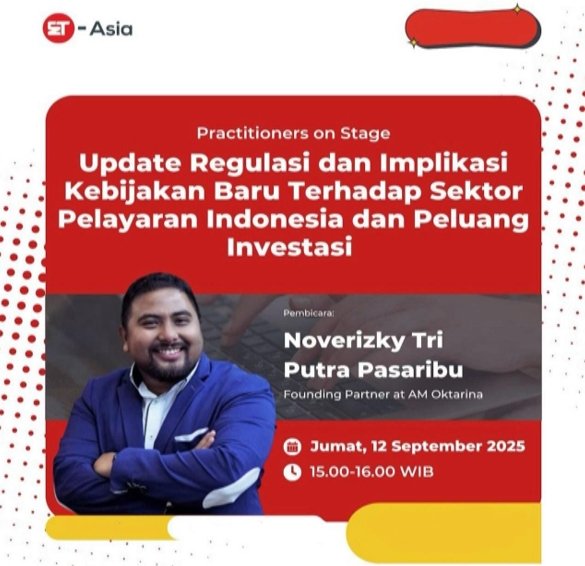
Contributors   :    Pramudya    Yudhatama,    S.H.,    C.L.A.,    and    Anis                      Sambuaga Telaumbanua, S.H. Reviewer          :    Noverizky Tri Putra Pasaribu, S.H., LL.M. (Adv.) Febrianda Pasaribu, M.Sc On Friday, September 12th 2025, AM Oktarina Counsellors at Law (“AMO”) had the honor of participating in the ET Asia Webinar titled “Pembaruan Regulasi dan Kebijakan Pelayaran: Implikasi Strategis bagi Investasi di Indonesia” (“Regulatory and Policy Updates in Shipping: Strategic Implications for Investment in Indonesia”). The event served as a timely platform to discuss the transformative changes introduced under Law No. 66 of 2024 on Shipping, which amends the previous Shipping Law No. 17 of 2008. It brought together stakeholders across the maritime sector, including legal practitioners, shipping companies, investors, and policymakers, to explore both opportunities and challenges in navigating Indonesia’s evolving maritime legal landscape. The session was led by Mr. Noverizky Tri Putra Pasaribu, S.H., LL.M. (Adv.), Managing Partner of AM Oktarina Counsellors at Law. With extensive academic training in international and European business law (Leiden University) and professional recognition from leading   global institutions, Mr. Noverizky is regarded as a future star in commercial, corporate, and maritime law. His experience in handling high level transactions and policy discussions uniquely positioned him to provide comprehensive insights into the reforms. In addition, Mr. Febrianda Pasaribu, M.Sc., also joined the session and contributed valuable explanations and perspectives, particularly in relation to the practical and economic implications of the new shipping framework. His input enriched the discussion and provided the audience with a broader understanding of the reforms from both a legal and policy analysis standpoint. Indonesia, as an archipelagic state with more than 17,000 islands, relies heavily on maritime transport approximately 90% of its trade is conducted via sea routes. Recognizing this strategic importance, the government enacted Law No. 66 of 2024 as the third amendment to the Shipping Law. The legislation aims to strengthen maritime sovereignty, enhance safety and efficiency, empower small scale shipping, and attract greater investment into the sector. One of the most notable amendments introduced by Law No. 66 of 2024 is the reinforcement of the Cabotage Principle. The law unequivocally reaffirms that majority ownership in shipping companies must remain in the hands of Indonesian entities. While joint ventures with foreign investors are still permitted, the conditions have become considerably more stringent. Indonesian shareholders are required to hold a controlling interest, vessels deployed under such arrangements must have a minimum gross tonnage of 50,000, and all crew members must be Indonesian nationals. This legal framework seeks to preserve national control over domestic sea transportation while selectively opening limited avenues for foreign capital and technology transfer. Another key development lies in the empowerment of local or traditional shipping operators (“pelayaran rakyat”). Newly inserted provisions under Articles 15A to 15E impose a positive obligation on the Government to provide structural support to this sector. The forms of support include capacity building programs, infrastructure development, targeted financing schemes, and state subsidies. This initiative aims not only to safeguard Indonesia’s cultural maritime heritage but also to enhance inter island connectivity, particularly in underserved regions, while simultaneously stimulating local economic development. The legislation further codifies the mandatory nature of pioneer shipping services. Unlike the previous regime, where pioneer routes were largely considered a matter of discretionary policy, the State is now legally mandated to ensure the provision of shipping services to underdeveloped, frontier, and outermost the so called ‘3T’ regions in Indonesia (terdepan, tertinggal, and terluar). Such services are expressly recognized as a public obligation, with financial support sourced from both central and regional government budgets. Significant changes are also made in the area of port governance and tariff regulation. The nomenclature of port authorities has been standardized to “Otoritas Penyelenggara Pelabuhan,” thereby harmonizing administrative structures across the archipelago. Tariff setting mechanisms have been clarified, requiring a higher degree of transparency, accountability, and government oversight where necessary. Moreover, stevedoring operators are legally required to establish partnerships with local micro, small, and medium sized   enterprises (“UMKM”), thereby ensuring inclusivity and promoting fair competition within port activities. With respect to safety and judicial oversight, maritime safety supervision has been expanded to encompass security and environmental protection. The Maritime Court (“Mahkamah Pelayaran”) has been elevated to a permanent judicial institution with extended jurisdiction, including the authority to summon shipowners in addition to captains and crew members. Sanctions against foreign vessels breaching Indonesian maritime zones have also been significantly strengthened, with penalties now extending up to 11 years of imprisonment and fines of up to IDR 5 billion. These measures are intended to fortify maritime sovereignty and align Indonesia with international best practices in maritime safety and enforcement. Finally, the law introduces enhanced financing mechanisms and fiscal incentives. Government support is no longer confined to tax relief; it now encompasses broader financing schemes and the possibility of long term contractual partnerships between shipowners and cargo owners. These measures are designed to reduce investment risks, accelerate fleet modernization, and increase the overall efficiency of Indonesia’s national logistics system. Mr. Noverizky emphasized that the reforms strike a balance between protecting national interests and attracting investment. By reinforcing the cabotage principle, Indonesia safeguards its maritime sovereignty, while selective joint ventures allow foreign expertise and capital to enter the market under strict safeguards. At the same time, the law introduces inclusivity measures by empowering pelayaran rakyat and UMKM, ensuring that smaller players remain part of the maritime ecosystem. However, the requirement for vessels of GT 50,000 in joint ventures presents significant barriers to entry for medium sized companies, highlighting the need for tailored financing solutions. Mr. Noverizky also underlined several transitional challenges arising from the enactment of Law No. 66 of 2024. First, compliance with the newly established tariff governance framework is expected to increase logistics costs and may necessitate the renegotiation of existing contractual arrangements. Second, the requirement to upgrade safety standards and adopt modern technologies will inevitably demand substantial capital investment, which could pose a considerable burden, particularly for small and medium sized operators. Third, the statutory timeline for transition most notably the

AM Oktarina Counsellors at Law’s Participation in ET Asia Webinar: Pembaruan Regulasi dan Kebijakan Pelayaran: Implikasi Strategis bagi Investasi di Indonesia Read More »

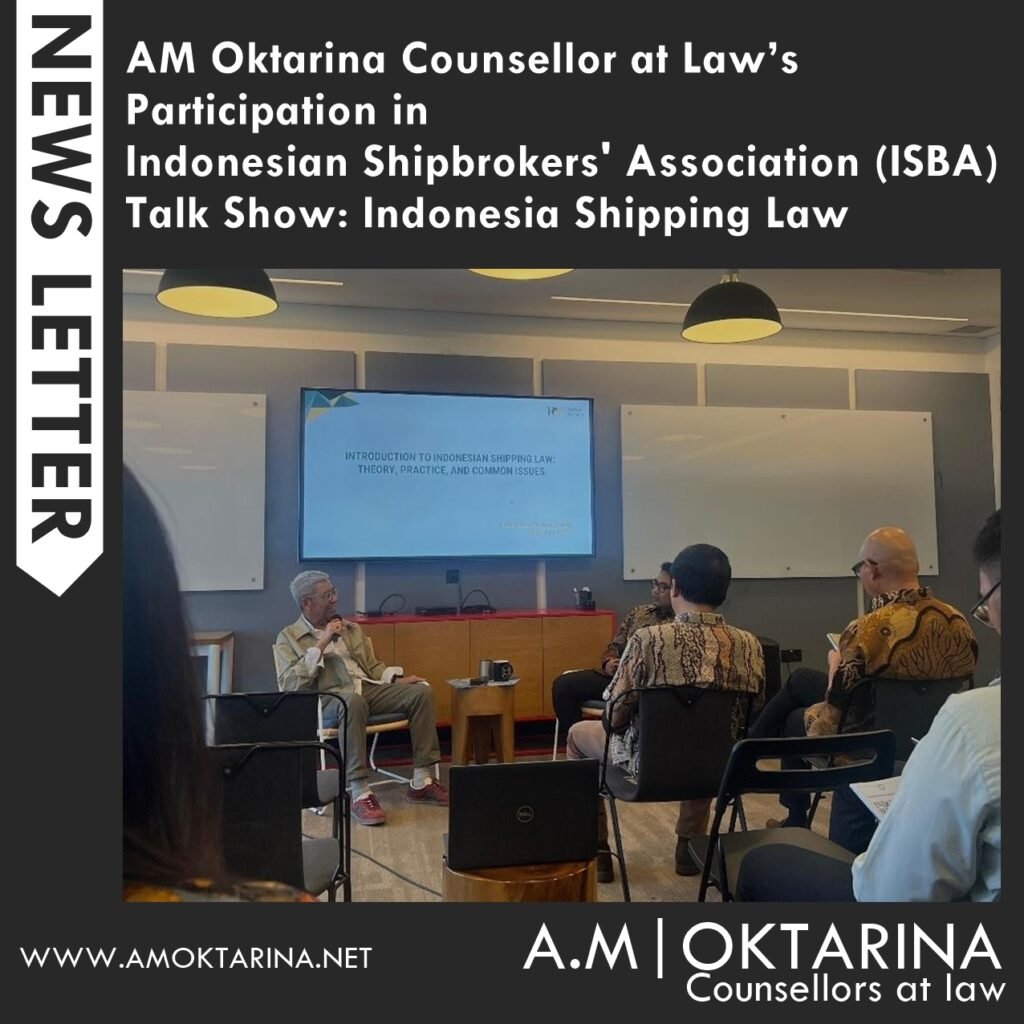
AM Oktarina Counsellor at Law’s Participation in Indonesian Shipbrokers’ Association (ISBA) Talk Show: Indonesia Shipping Law

Contributors     :   Pramudya Yudhatama, S.H., C.LA., Khaifa Muna Noer Uh’dina, S.H., and Anis Sambuaga Telaumbanua, S.H. Reviewer            :   Noverizky Tri Putra Pasaribu S.H. LL.M. (Adv.) and Febrianda Pasaribu, M.Sc   On Thursday, July 31st, 2025, AM Oktarina Counsellor at Law (“AMO”) had the opportunity to participate in a talk show entitled “(ISBA) Talk Show: Indonesia Shipping Law” organized as  part  of  the  Indonesian  Shipbrokers Association  (“ISBA”)  located  at  29D  Classroom, WeWork Noble House, 30th floor, Mega Kuningan No. 2, Jl. Dr. Ide Anak Agung Gde Agung Kav. E 4.2, Jakarta 12950. The event aimed to enhance understanding of Indonesian shipping law while fostering dialogue among legal practitioners and key stakeholders in the shipping and logistics industry.   ISBA is a professional association engaged in shipbroking, which involves acting as an intermediary in the sale, purchase, and chartering of vessels within the maritime sector. One of the partners at AMO, Febrianda Pasaribu, M.Sc, is an active member of ISBA and contributes to the ongoing development of the shipbroking industry in Indonesia.   Our firm was represented by Pramudya Yudhatama, S.H., C.L.A. and Khaifa Muna Noer Uh’dina, S.H. Their attendance underscored our firm’s commitment to continuously enhance human capital through participation in professional development forums, and to actively engage in strategic discussions regarding reforms in the maritime and transportation legal sectors.   Indonesian shipping law is fundamentally divided into two major branches: wet shipping and dry shipping. Wet shipping concerns maritime incidents that occur during the operation of a vessel, including collisions, pollution, salvage operations, and wreck removal. Dry shipping, in contrast, covers contractual and documentary matters, such as the issuance and enforcement of bills of lading, charter party agreements, ship financing, and vessel registration. Together, these two branches form the foundation of maritime law practice in Indonesia.   The legal framework governing Indonesian shipping activities is drawn from multiple sources. These include the Indonesian Commercial Code (Kitab Undang-Undang Hukum Dagang or KUHD), Law No. 17 of 2008 on Shipping, as last amended by Law No. 66 of 2024, and a variety of ministerial and governmental regulations, such as the Minister of Transportation Regulation No. 39 of 2017 on Vessel Registration and Nationality and Minister of Transportation Regulation No. 2 of 2021 on the Use of Foreign Vessels. In addition, Indonesia refers to several key international conventions, although not all are ratified. These include the International Convention for the Safety of Life at Sea 1974 (SOLAS), the Convention on the International Regulations for Preventing Collisions at Sea 1972 (COLREG), the Maritime Labour Convention 2006 (MLC), and the Nairobi International Convention on the Removal of Wrecks 1982.   Within the dry shipping domain, the bill of lading plays a central role. Recognised as a valid contract of carriage by Supreme Court Decision No. 716 K/Pdt/1984, the bill of lading is regulated under Articles 505 to 510 of the Indonesian Commercial Code. This document serves as written evidence that the carrier has received specific cargo with the intention to transport and deliver it to a named consignee under agreed terms. It may be issued by the master of the vessel or another authorised party, and the lawful holder of the bill retains the right to sue. The carriage of goods by sea typically involves several actors: the carrier (usually the shipowner or operator), the shipper (who initiates shipment), the consignee (the party entitled to receive the goods), the notify party (often a customs broker or forwarder), and the freight forwarder who facilitates  cargo  movement. The master,  as  the legal  representative of  the shipowner,  is responsible for the safe operation and navigation of the vessel.   Charter party agreements are categorised into three main types under Indonesian law: voyage charters, time charters, and bareboat or demise charters. In a voyage charter, the vessel is hired for a specific journey, and the shipowner remains responsible for crewing, navigation, and operation. In a time charter, the vessel is leased for a defined period, but control over navigation and maintenance generally remains with the owner. Under a bareboat charter, the charterer assumes full responsibility, including crewing and operating the vessel, effectively taking on the role of the shipowner for the charter duration.   Ship registration in Indonesia is subject to strict eligibility requirements. Only vessels of at least  7  (seven) gross  tonnage (“GT”) may  be  registered,  and  ownership  is  restricted  to Indonesian citizens, Indonesian legal entities, or joint ventures in which Indonesian parties hold   at least 51 percent of the shares. Indonesia employs a closed registry system, meaning dual registration of Indonesian flagged vessels in foreign jurisdictions is prohibited. Owners may select any designated port for registration, provided that they submit all required documentation, including the measurement certificate, proof of ownership (such as a bill of sale or notarial deed), the owner’s identity, and any necessary permits. Deletion of a vessel from the registry may occur due to total loss, foreign transfer, scrapping, piracy, or pursuant to a binding court decision.   Ship finance arrangements typically begin with a legal due diligence process, followed by the negotiation and execution of a sale and purchase agreement, most commonly using the Norwegian Sale Form (NSF) 2012. The buyer and seller then coordinate with financial institutions and complete the title transfer and registration procedures to perfect ownership and enable lawful operation of the vessel under Indonesian law.   In matters of wet shipping, liability for ship collisions is determined under Articles 534 to 537 of the Indonesian Commercial Code and supplemented by the Shipping Law. The degree of fault attributable to each vessel governs the apportionment of liability. Where the cause of collision is uncertain or attributable to force majeure, each party bears its own loss. If fault lies entirely with one vessel, that party bears full liability for damages. In cases of shared fault, damages  are  apportioned  proportionally. Administrative  sanctions  arising  from  maritime accidents are regulated under Government Regulation No. 9 of 2019, ranging from warnings to suspension of seafarer certificates for up to twenty four months depending

AM Oktarina Counsellor at Law’s Participation in Indonesian Shipbrokers’ Association (ISBA) Talk Show: Indonesia Shipping Law Read More »

Piercing the Corporate Veil in the Indonesian Legal System: Personal Liability of the Limited Liability

  Contributor: Aflah Abdurrahim, S.H. Pramudya Yudhatama, S.H., C.L.A., Aiman Akbar Nasution, S.H. Reviewer: Noverizky Tri Putra Pasaribu, S.H., L.LM. (Adv).   A. Background Perseroan Terbatas (PT) merupakan badan hukum yang berdiri sendiri dari pemilik dan pengurus perusahaan yang terpisah dari perseroan terbatas dan masih merujuk pada ketentuan tanggung jawab terbatas yang dimiliki oleh saham perseroan terbatas (limited liability) dan perusahaan merupakan sebuah entitas hukum terpisah A. Background Limited Liability Company (PT) is a legal entity that stands independently from its owners and company managers. It is separate from the limited liability company itself and adheres to the principle of limited liability inherent in the company’s shares. The company is a distinct legal entity from its directors, commissioners, and dari direktur, komisaris maupun pemegang saham (separated legal entity). Namun dalam perkembangan hukum di Indonesia, Prinsip limited liability maupun separated legal entity tidak berlaku mutlak sejak dikenal doktrin piercing the corporate veil, yang memungkinkan untuk mengabaikan pemisahan antara entitas pemegang saham, komisaris maupun direksi dengan entitas perseroan terbatas sebagai badan hukum dalam tindakan hukum tertentu. Kekebalan yang biasa dimiliki oleh pemegang saham, direksi dan komisaris karena tanggung jawabnya terbatas, dapat dibuka dan diterobos menjadi tanggung jawab tidak terbatas hingga kekayaan pribadi apabila terjadi pelanggaran, penyimpangan atau kesalahan dalam melakukan pengurusan perseroan terbatas. Di Indonesia penerapan prinsip piercing the corporate veil memang belum banyak ditemukan, namun eksistensi prinsip tersebut dapat dilihat dari beberapa kasus yang telah terjadi. Salah satu kasus yang menerapkan prinsip piercing the corporate veil dapat kita lihat dalam putusan Putusan MA No:89PK/Pdt/2010 yang menyatakan bahwa PT Effem Foods Inc (holding company) selaku pemegang saham bertanggung jawab atas perbuatan hukum PT Effem Indonesia (subsidiary company) terhadap PT Smak Snak (pihak ketiga) dan Putusan Mahkamah Agung Nomor: 863/PK/Pdt/2019 yang menyatakan bahwa PT. Bank Global Internasional Tbk beserta para organ diantaranya yaitu Direksi, Dewan Komisaris dan Pemegang Saham bertanggung jawab secara tanggung renteng untuk mengganti kerugian yang dialami para penggugat karena terbukti melakukan tindak pidana dengan menerbitkan reksadana fiktif dan memberikan informasi tidak benar yang langsung disampaikan oleh shareholders. However, in the development of law in Indonesia, the principles of limited liability and separate legal entity are not absolute due to the recognition of the doctrine of piercing the corporate veil. This doctrine allows the legal separation between shareholders, commissioners, and directors from the company as a legal entity to be disregarded in certain legal actions. The immunity typically enjoyed by shareholders, directors, and commissioners due to their limited liability can be lifted, exposing them to unlimited liability—including personal assets—when violations, deviations, or mismanagement of the company occur. In Indonesia, the application of the piercing the corporate veil principle is still rare, but its existence can be seen in several court cases. One example is Supreme Court Decision No: 89PK/Pdt/2010, which stated that PT Effem Foods Inc (holding company), as the shareholder, was held responsible for the legal actions of PT Effem Indonesia (subsidiary company) against PT Smak Snak (third party). Another example is Supreme Court Decision No: 863/PK/Pdt/2019, which ruled that PT Bank Global Internasional Tbk and its corporate organs—including Directors, Board          of          Commissioners,          and Shareholders—were jointly liable to compensate the plaintiffs for proven criminal acts such as issuing fictitious mutual funds and providing false information directly conveyed by the bank’s director. So, what happens if shareholders, commissioners, or directors are held accountable for the legal actions of a limited liability company? Shouldn’t they be legally separated? In this article, we will explore how the piercing the corporate veil doctrine Direktur Bank Global . Bagaimana jadinya jika pemegang saham, komisaris ataupun direksi harus menanggung akibat dari perbuatan hukum perseroan terbatas? Bukankah seharusnya mereka terpisah secara hukum? Dalam artikel ini, kita akan membahas bagaimana doktrin piercing the corporate veil ini berlaku di Indonesia, serta sejauh mana holding company bisa ikut bertanggung jawab terhadap perbuatan hukum yamg dilakukan anak perusahaan. B. Legal Basis Kitab Undang-Undang Hukum Perdata (“KUH Perdata”) Undang-undang Nomor 40 Tahun 2007 Tentang Perseroan Terbatas (“UU PT”) Putusan Peninjauan        Kembali Mahkamah Agung Republik Indonesia No: 89PK/Pdt/2010 (“Putusan MA 2010”) Putusan Mahkamah Agung Nomor: 863/PK/Pdt/2019 (“Putusan MA 2019”) Meskipun tidak diatur secara eksplisit dalam peraturan perundang-undangan di Indonesia, namun eksistensi doktrin piercing the corporate veil dapat ditemukan dalam peraturan perundang-undangan dan putusan pengadilan yang telah berkekuatan hukum tetap (inkrach van gewijsde) yang mana dengan kata lain adalah yurisprudensi, yaitu: UU PT  Pasal 3 UU PT: 1) “Pemegang saham Perseroan tidak bertanggung jawab secara pribadi atas perikatan yang applies in Indonesia and to what extent a holding company can be held liable for legal actions carried out by its subsidiary. B. Legal Basis Indonesia Civil Code (“Civil Code”) Law Number 40 of 2007 concerning Limited Liability Companies (“Company Law”) Judicial Review  Decision            of         the Supreme Court of the Republic of Indonesia No: 89PK/Pdt/2010 (“Supreme Court Decision 2010”) Supreme Court Decision of the Republic of Indonesia No: 863/PK/Pdt/2019 (Supreme Court Decision 2019”) Although not explicitly regulated in Indonesian legislation, the existence of the doctrine of piercing the corporate veil can be found in statutory regulations and court decisions that have permanent legal force (inkracht van gewijsde), which in other words constitute jurisprudence, namely: Company Law  Article 3 of the Company Law: “Shareholders of the Company shall not be personally liable for any commitments made on behalf dibuat atas nama Perseroan dan tidak bertanggung jawab atas kerugian Perseroan melebihi saham yang dimiliki.” “Ketentuan sebagaimana dimaksud pada ayat (1) tidak berlaku apabila: persyaratan Perseroan sebagai badan hukum belum atau tidak terpenuhi; pemegang saham yang bersangkutan baik langsung maupun tidak langsung dengan itikad buruk memanfaatkan Perseroan untuk kepentingan pribadi; pemegang saham yang bersangkutan terlibat dalam perbuatan melawan hukum yang dilakukan oleh Perseroan; atau pemegang saham yang bersangkutan baik langsung maupun tidak langsung secara melawan hukum menggunakan kekayaan Perseroan, yang mengakibatkan kekayaan Perseroan menjadi tidak cukup untuk melunasi utang Perseroan.”  Pasal 69 ayat 3 UU PT: “Dalam hal laporan keuangan yang disediakan ternyata tidak benar dan/atau menyesatkan, anggota Direksi dan anggota Dewan Komisaris secara tanggung renteng bertanggung jawab terhadap pihak yang dirugikan.”  Pasal

Piercing the Corporate Veil in the Indonesian Legal System: Personal Liability of the Limited Liability Read More »

ANALYSIS REGULATION OF CERTIFICATION OF ORIGIN

From : A.M Oktarina Counsellor at Law Contributors : Pramudya Yudhatama, S.H., C.L.A., Khaifa Muna Noer Uhdina, S.H., Hana Khairunisa, S.H., and Najla Zulkarnain, S.H Reviewer : Noverizky Tri Putra Pasaribu, S.H., L.L.M (Adv)   Background The current condition of Indonesia’s exports and imports shows a quite positive trend despite facing various global challenges. Sourced from the Badan Pusat Statistik ( “BPS”) “Nilai ekspor Indonesia Januari 2024 mencapai US$20,52 miliar Menurut provinsi asal barang, ekspor Indonesia terbesar pada Januari 2024 berasal dari Jawa Barat dengan nilai US$2,95 miliar (14,35 persen), diikuti Kalimantan Timur US$2,17 miliar (10,58 persen) dan Jawa Timur US$1,99 miliar (9,68 persen)” (as the link attached). In essence, export-import activities are very important for the continuity of the national economy, namely as a very reliable foreign exchange earner. Therefore, the Indonesian government always carries out various efforts to increase exports, one of which is by issuing Decree of the Minister of Industry and Trade of the Republic of Indonesia Number 130/MPP/Kep/6/1996 concerning Certificates of Origin (“SKA”), especially certificates of origin for Indonesian export goods.   B. Legal Basis Minister of Trade Regulation No. 77 of 2014 Concerning Provinsi on the Origin of Indonesian Goods/Rules of Origin of Indonesia ( Permendag No. 77 Tahun 2014) Minister of Trade Regulation No. 34 of 2023 Concerning Provinsi and Procedures for Issuing Certificates of Origin for Goods from Indonesia ( Permendag No.34 Tahun 2023) Minister of Trade Regulation No. 25 of 2018 Concerning Surat Keterangan Asal Issuing Agencies ( Permendag  No.25 Tahun 2018) Minister of Trade Regulation No. 111 of 2018 Concerning Provisions and Procedures for Making Declarations of Origin for Goods from Indonesia ( Permendag No.111 Tahun 2018)     Referring to Law Number 34 of 2023 concerning the Fourth Amendment to Regulation of the Minister of Trade Number 24 of 2018 concerning Provisions and Procedures for Issuing Certificates of Goods of Indonesian Origin Article 1 paragraph (2):     “A Certificate of Origin is a document that proves that Indonesian exported goods have complied with the Indonesian Rules of Origin, where it is stated in the certificate that the exported goods/commodities originate from the export region/country.”     SKA can only be issued by the SKA issuing agency (“IPSKA”) determined by the Minister of Trade. This is regulated in the Minister of Trade Regulation No. 25 of 2018 concerning the Issuing Agency for Certificates of Origin (SKA) and is issued through the SKA electronic system (“e- SKA”). Exporters can only apply for SKA issuance via e-SKA after obtaining access rights granted by IPSKA.     SKA includes preferential SKA and non-preferential SKA. Preferential SKA is used for Indonesian export goods to obtain a reduction or exemption from import duty tariffs:     a. by a country or group of countries based on the provisions of an agreed international agreement; or based on the unilateral determination of a country or group of export destination countries.     Meanwhile, non-preferential SKA is used for Indonesian export goods without obtaining reduction facility or exemption from import duties.       Certificates of Origin (SKA) have an important role in international trade, especially in supporting a country’s  export  activities.  SKA is  needed  to  obtain  preferential  facilities  in  the form  of reductions or exemptions from import duties to export destination countries that are members of certain trade agreements. In addition, the SKA functions as the main document that allows Indonesian export commodities to be accepted on the international market in accordance with the regulations of the destination country.     The procedure for issuing a Certificate of Origin ( “SKA” ) : The exporter submits an application to an authorized institution, such as the Trade Service or KADIN. Supporting documents such as invoices, packing lists and bills of lading must be prepared. If there is a tariff preference facility, the rules of origin of the goods must be fulfilled. SKA applications are submitted via e-SKA(https://ska.kemendag.go.id/login) or directly to the issuing office. The process takes 2-5 working days. Officers verify documents and, if necessary, conduct physical inspections. If the requirements are met, the SKA is issued in physical or digital form. Exporters include SKA in export documents to be processed by customs in the destination country.     This SKA functions as proof that the goods originate from the country agreed upon in the trade agreement, so that they can obtain tariff facilities or exemption from import duties in accordance with applicable regulations. To ensure the smooth running of this process, exporters also need to understand the SKA regulations and provisions that apply in the export destination country.     As one of the ASEAN member countries and to  increase the smoothness of exports to ASEAN member countries and adapt the rules to amendments to the Operational Certification Procedures (OCP) of the ASEAN Trade in Goods Agreement (ATIGA), Indonesia and other ASEAN countries have determined the types of goods produced or obtained as a whole in member countries which have been stipulated in number 3 of Appendix 1 of the Minister of Trade Regulation No. 32 of 2022, namely: plants and their products, animals born and raised, products from live animals, hunting and cultivation products, natural mineral materials, marine fishery products, goods from the deep sea, goods from processing vessels, used goods for recycling, production, and goods originating from the previous categories. Meanwhile, the types of goods that are not obtained or produced by member countries as a whole are specified in number 4 of Appendix 1 to Regulation of the Minister of Trade Number 32 of 2022.       Certificates of Origin (SKA) have an important role in international trade, especially in supporting a country’s  export  activities.  SKA is  needed  to  obtain  preferential  facilities  in  the form  of reductions or exemptions from import duties to export destination countries that are members of certain trade agreements. In addition, the SKA functions as the main document that allows Indonesian export commodities to be accepted on the international market in accordance with the regulations of the

ANALYSIS REGULATION OF CERTIFICATION OF ORIGIN Read More »

AM Oktarina Counsellors At Law Sukses Eksekusi Kedutaan Besar Negara Kerajaan Arab Saudi, Bukti Supremasi Hukum di Indonesia!

Contributor: Muhammad Ardin Ardiansyah, S.H. Reviewer: Noverizky Tri Putra Pasaribu, S.H., L.LM. (Adv). Aflah Abdurrahim, S.H.   Background   Dalam proses peradilan di Indonesia eksekusi putusan pengadilan yang telah berkekuatan hukum tetap (inkracht van gewijsde) merupakan aspek fundamental dalam sistem hukum yang menjamin kepastian dan keadilan bagi pihak yang memenangkan perkara. Dalam perkara Persekutuan Perdata A.M. Oktarina Counsellors at Law vs. Kedutaan Besar Negara Kerajaan Arab Saudi di Indonesia, Pengadilan Negeri Jakarta Selatan telah mengabulkan permohonan eksekusi yang diajukan oleh Pemohon.   Keberhasilan ini menandai langkah penting dalam menegakkan supremasi hukum, terutama dalam konteks eksekusi terhadap subjek hukum yang memiliki status diplomatik. Artikel ini akan mengulas latar belakang perkara, proses eksekusi, dan dampaknya terhadap kepastian hukum di Indonesia.         Latar Belakang Perkara         Perkara ini berawal dari gugatan yang diajukan  oleh  Persekutuan  Perdata  A.M. A. Background     In the judicial process in Indonesia, the execution of court decisions that have obtained permanent legal force (inkracht van gewijsde) is a fundamental aspect of the legal system, ensuring certainty and justice for the victorious party. In the case of the Civil Partnership A.M. Oktarina Counsellors at Law vs. The Embassy of the Kingdom of Saudi Arabia in Indonesia, the South Jakarta District Court granted the execution request submitted by the Applicant.       This success marks an important step in upholding the rule of law, particularly in the context of executing against a legal subject   with   diplomatic   status.   This article will review the background of the case, the execution process, and its impact on legal certainty in Indonesia.             Background of the Case         The case originated from a lawsuit filed by the Civil Partnership A.M. Oktarina       Oktarina Counsellors at Law terhadap Kedutaan   Besar   Negara   Kerajaan   Arab Saudi di Indonesia serta beberapa pihak terkait. Dalam putusan PN Jakarta Selatan No. 297/Pdt.G/2023/PN.Jkt.Sel, pengadilan menyatakan   bahwa   Termohon   Eksekusi telah  melakukan  Perbuatan  Melawan Hukum  (PMH)  dengan  tidak mengembalikan  biaya  yang  telah dikeluarkan Pemohon untuk penyelesaian sengketa.         Pihak-Pihak      yang      Terlibat      dalam   Sengketa:   Pemohon Eksekusi:   Persekutuan  Perdata    A.M.    Oktarina   Counsellors at Law       Termohon Eksekusi:   Kedutaan Besar  Negara  Kerajaan  Arab   Saudi di Indonesia   A.A.A.D (Eks     Kepala     Bagian Perlindungan   Warga   Negara   Kedubes Arab Saudi) K.A.T.A (Warga Negara Arab Saudi)   4. Kementerian    Luar    Negeri    Republik   Indonesia (cq. Direktur Timur Tengah) Counsellors at Law against the Embassy of the Kingdom of Saudi Arabia in Indonesia and several related parties. In its                     decision                     No. 297/Pdt.G/2023/PN.Jkt.Sel, the court stated that the Respondent in the execution had committed an unlawful act by failing to reimburse the costs incurred by the Applicant for the settlement of the dispute.             Parties Involved in the Dispute:       Applicant for Execution:   Civil   Partnership   A.M.   Oktarina   Counsellors at Law       Respondents in the Execution:   The Embassy of the Kingdom of Saudi   Arabia in Indonesia   A.A.A.D (Former Head of the Saudi   Embassy’s Citizen Protection Division)       K.A.T.A (Saudi National)   Ministry of Foreign Affairs of the Republic of Indonesia (represented by the Director of the Middle East)       Pada tanggal 14 September 2020, Kementerian Luar Negeri Republik Indonesia mengirimkan nota diplomatik No. D/01955/09/2020/31 kepada Kedutaan Besar Kerajaan Arab Saudi di Jakarta. Dalam nota diplomatik tersebut, Kementerian Luar Negeri menyampaikan beberapa hal penting terkait sebuah kasus hukum yang melibatkan Kedutaan Besar Kerajaan Arab Saudi di Jakarta.   Kementerian Luar Negeri Republik Indonesia menginformasikan bahwa mereka telah menerima informasi mengenai isi putusan dari Pengadilan Negeri Jakarta Selatan dalam perkara gugatan yang diajukan oleh firma hukum A.M. Oktarina (AMO) terhadap Kedutaan Besar Kerajaan Arab Saudi di Jakarta. Putusan tersebut tercantum dalam nomor perkara 297/Pdt.G/2023/PN.Jkt.Sel.   Dalam putusannya, Majelis Hakim memutuskan untuk menghukum dan memerintahkan Kedutaan Besar Kerajaan Arab Saudi di Jakarta, yang menjadi “Tergugat I” dalam perkara tersebut, untuk membayar ganti kerugian materiil sebesar Rp 375.000.000,00 (tiga ratus tujuh puluh lima juta rupiah) kepada AMO. Selain itu, para tergugat, termasuk Kedutaan Besar Kerajaan     Arab     Saudi     di     Jakarta, On September 14, 2020, the Ministry of Foreign Affairs of the Republic of Indonesia sent Diplomatic Note No. D/01955/09/2020/31 to the Embassy of the Kingdom of Saudi Arabia in Jakarta. The note addressed several key issues related to a legal case involving the Saudi Embassy.           The Ministry of Foreign Affairs informed that it had received information about the content of the judgment from the South Jakarta District Court regarding the lawsuit filed by the A.M. Oktarina law firm against the Embassy of the Kingdom of Saudi Arabia in Jakarta. The judgment was   registered   under   case   number 297/Pdt.G/2023/PN.Jkt.Sel.         In its ruling, the Court decided to order the Embassy of the Kingdom of Saudi Arabia in Jakarta (the “Defendant”) to pay     material     damages     of     IDR 375,000,000 (three hundred seventy-five million rupiahs) to A.M. Oktarina Counsellors at Law. Additionally, the Defendants, including  the Saudi Embassy, were ordered to pay court fees amounting to IDR 5,650,000 (five million       diwajibkan untuk membayar biaya perkara sebesar Rp 5.650.000,00 (lima juta enam ratus lima puluh ribu rupiah).   Sehubungan dengan putusan tersebut, Kementerian Luar Negeri Republik Indonesia mengharapkan agar Kedutaan Besar Kerajaan Arab Saudi di Jakarta dapat menindaklanjuti hasil putusan tersebut dan berupaya menyelesaikan permasalahan ini secara baik dan memuaskan bagi semua pihak yang terlibat.   Pada kesempatan tersebut, Kementerian Luar Negeri juga menyampaikan penghargaan yang setinggi-tingginya kepada Kedutaan Besar Kerajaan Arab Saudi di Jakarta atas perhatian dan kerjasama yang telah diberikan.       Putusan     Pengadilan     yang     Telah   Memiliki Hak Eksekutorial   Pengadilan Negeri Jakarta Selatan dalam putusannya menyatakan bahwa para Termohon telah melakukan Perbuatan Melawan Hukum dengan tidak memenuhi kewajibannya  terhadap  Pemohon Eksekusi. Amar putusan yang utama adalah: Menghukum Kedutaan Besar Negara Kerajaan Arab  Saudi  untuk membayar ganti rugi materil sebesar six hundred fifty thousand rupiahs).             Following

AM Oktarina Counsellors At Law Sukses Eksekusi Kedutaan Besar Negara Kerajaan Arab Saudi, Bukti Supremasi Hukum di Indonesia! Read More »

Contempt of Court in the Indonesian Legal System: Implications for Legal Certainty and Judicial Authority

Contributor: Muhammad Ardin Ardiansyah, S.H. Reviewer: Noverizky Tri Putra Pasaribu, S.H., L.LM. (Adv). Aflah Abdurrahim, S.H.   Background   Contempt of court adalah tindakan yang merendahkan, menghambat, atau mencederai kewibawaan serta integritas peradilan. Dalam sistem hukum Indonesia, konsep ini memiliki urgensi tinggi dalam menjaga supremasi hukum dan mencegah gangguan terhadap proses peradilan.   Namun, hingga kini, pengaturan contempt of court di Indonesia belum memiliki undang-undang khusus yang secara eksplisit mengaturnya, sehingga praktik penerapannya sering mengacu pada berbagai ketentuan dalam KUHAP, KUHP, UU Kekuasaan Kehakiman, dan peraturan terkait lainnya.         Artikel ini akan mengkaji konsep contempt of court, dasar hukumnya di Indonesia, serta implikasi terhadap kepastian hukum dan kewibawaan peradilan.         B. Legal Basis   Contempt of Court  belum diatur secara tegas didalam peraturan perundang- undangan     di     Indonesia.     Namun, Background     Contempt of court refers to actions that diminish, hinder, or violate the authority  and  integrity  of  the judiciary. In the Indonesian legal system, this concept plays a crucial role in maintaining the supremacy of law and preventing disruptions to legal proceedings.   However, Indonesia currently lacks a specific law that explicitly regulates contempt of court, resulting in its application often referring to various provisions in the Criminal Code (KUHP), the Code of Criminal Procedure (KUHAP), the Judicial Power Law, and other relevant regulations.         This article aims to examine the concept of contempt of court, its legal basis in Indonesia, and the implications  for  legal  certainty  and the authority of the judiciary.         Legal Basis   Contempt of court has not been explicitly regulated in Indonesian legislation. However, it is addressed   Contempt of Court diatur sebagaimana pada peraturan perundang-undangan di Indonesia, antara lain: Kitab Undang-Undang Hukum Pidana (“KUHP”) Pasal 217 KUHP “Barang siapa dengan sengaja mengganggu rapat umum yang tidak terlarang, dihukum penjara selama- lamanya tiga minggu atau denda sebanyak-banyaknya sembilan ratus rupiah.”   Kitab Undang-Undang  Hukum  Acara Pidana (“KUHAP”) Pasal 218 KUHAP: 1)  Setiap orang yang hadir dalam sidang pengadilan wajib menunjukkan sikap hormat kepada pengadilan. 2)  Dalam hal seseorang yang hadir dalam sidang pengadilan bersikap tidak sesuai dengan martabat pengadilan dan tidak menaati tata tertib setelah mendapat peringatan dari hakim ketua sidang, atas perintahnya yang bersangkutan dikeluarkan dari ruang sidang. in various legal provisions, including:                   Criminal Code (“KUHP”) Article 217 KUHP: “Anyone who intentionally disturbs a public meeting that is not prohibited shall be punished with imprisonment for a maximum of three weeks or a fine not exceeding nine hundred rupiahs.” Code   of   Criminal   Procedure (“KUHAP”) Article 218 KUHAP: 1) Every  person  attending  a  court session must show respect for the court. 2) If   a   person   attending   a   court session behaves inappropriately and fails to comply with court rules after receiving a warning from the presiding judge, that person may be removed from the courtroom by order of the judge. 3) If such misconduct is classified as a criminal act, the perpetrator may       3) Dalam hal pelanggaran tata tertib tersebut termasuk suatu tindak pidana, maka pelakunya dapat dituntut.                     Peraturan Mahkamah Agung Republik   Indonesia    Nomor    5    Tahun    2020   Tentang Protokol Persidangan Dan Keamanan Dalam Lingkungan Pengadilan (“Perma 5/2020”) Pasal 6 Perma 5/2020   1) Selama          sidang          berlangsung, pengunjung sidang harus duduk dengan sopan di tempat duduk masing-masing dan        memelihara    ketertiban    dalam sidang. 2) Hakim/Ketua Majelis Hakim memimpin pemeriksaan dan memelihara tata tertib di  Persidangan. 3) Segala sesuatu yang diperintahkan oleh Hakim/Ketua Majelis Hakim untuk memelihara tata tertib di Persidangan wajib dilaksanakan dengan segera dan cermat. 4) Hakim/Ketua   Majelis   Hakim   dapat menentukan bahwa anak yang belum mencapai umur 17 (tujuh belas) tahun be prosecuted.                               Supreme Court Regulation No. 5 of   2020 on Court Protocols and Security in  Judicial  Environments  (“Perma 5/2020”)       Article 6 Perma 5/2020:   1)  During the trial, court visitors must sit properly in their designated seats and maintain order in the courtroom.     2)  Judges/Presiding Judges shall lead the    proceedings   and    maintain order in the trial. 3) All  directives  issued  by  the judge/presiding judge to maintain order in the trial must be followed promptly and diligently.     4)    The  judge/presiding  judge  may rule that individuals under 17 years of age are not allowed to attend the trial.       tidak      diperkenankan      menghadiri sidang. 5) Kehadiran        anak        sebagaimana dimaksud pada ayat (4) di dalam Persidangan dimungkinkan sepanjang sesuai dengan ketentuan peraturan perundang-undangan. 6) Setiap  Orang  yang  hadir  di  ruang sidang yang bersikap tidak sesuai dengan martabat Pengadilan dan tidak mematuhi tata tertib, diberikan peringatan dari Hakim/Ketua Majelis Hakim. 7) Setelah         mendapat         peringatan sebagaimana dimaksud pada ayat (6) atas perintah Hakim/Ketua Majelis Hakim, Orang yang bersikap tidak sesuai  dengan  martabat  Pengadilan dan tidak mematuhi tata tertib dapat dikeluarkan dari ruang sidang. 8) Dalam ha! pelanggaran tata tertib yang dilakukan bersifat suatu tindak pidana, tidak mengurangi kemungkinan dilakukan penuntutan terhadap pelakunya. 9) Setiap Orang yang keluar dan masuk ruang     sidang    pada    saat    sidang berlangsung, diwajibkan memberi hormat kepada Hakim/Majelis Hakim dengan menganggukkan kepala dan/ atau mengangkat tangan.         5)    The   attendance   of   minors   as mentioned in paragraph (4) may be allowed if in accordance with legal regulations.     6)    Any    individual    attending    the courtroom who behaves inappropriately or fails to comply with court rules will be warned by the judge/presiding judge.     7)    After  receiving  such  a  warning, that individual may be ordered to leave the courtroom by the judge/presiding judge.             8)    If  the  violation  of  court  rules constitutes a criminal act, legal prosecution may still be pursued.         9)    Every person entering or leaving the courtroom during a session is required to show respect to the judge/bench by nodding or raising their hand.           Definisi   dan   Bentuk   Contempt   of court

Contempt of Court in the Indonesian Legal System: Implications for Legal Certainty and Judicial Authority Read More »

ANALYSIS OF EUROPEAN UNION CERTAIN MEASURES CONCERNING PALM OIL AND OIL PALM CROP-BASED BIOFUELS REPORT OF THE PANEL NO. WT/DS593/R FROM THE PERSPECTIVE OF INDONESIA’S INTERESTS

From : A.M Oktarina Counsellors at Law Contributors : Pramudya Yudhatama, S.H., C.L.A., Khaifa Muna Noer Uhdina, S.H., and Hana Khairunisa, S.H. Reviewer : Noverizky Tri Putra Pasaribu, S.H., L.L.M (Adv).   A. Background     Looking at international trade regulations, it cannot be separated from the products to be sold. In this case, the Republic of Indonesia has played an important role in the international trade arena. One of the mainstay  commodities is palm oil. However, one of the export destinations for Indonesia, namely the European Union, implements regulations that “protect” its member states through several regulations issued. Thus, Indonesian palm oil products are subject to different legal enforcement, starting from their specifications and taxation. For this, the Indonesian government took legal steps and forwarded this matter to the World Trade Organization (“WTO”). After running, finally a panel report from the WTO was issued that benefited Indonesia. So, what are the points that benefit Indonesia? Let’s see the explanation below:     Legal Basis     General Agreement on Tariffs and Trade 1994 (“GATT”); Technical Barriers to Trade (“TBT”). Taxe Incitative Relative à l’Incorporation de Biocarburant (“TIRIB”); Directive (EU) 2018/2001 of the European Parliament and of the Council of  11 December 2018 on the promotion of the use of energy from renewable sources (recast), OJ 2018 L 328, p. 80 (“RED II”); European Union – Certain Measures Concerning Palm Oil And Oil Palm Crop-Based Biofuels Report Of The Panel No. WT/DS593/R (“Report DS593”)     Recently, social media has been enlivened with the results of the DS395 decision published by the WTO. This more or less affects Indonesia’s position. In terms of events, previously on December 9th, 2019, Indonesia requested consultation with the European Union regarding certain measures imposed by the European Union and its member states regarding palm oil and palm oil-based biofuels from Indonesia.     Through the panel process, in which several countries participated in the process, the object of discussion was the categorization of palm oil and biofuels. This is driven by the intention of the European Union to protect biofuels based on rapeseed oil and domestic soybean oil. However, this makes a difference with Indonesian palm oil.       This restriction is carried out by the European Union which has implemented restrictions on the risk of high indirect land use change (“ILUC”) and phased it out. However, this is done inconsistently and contrary to the TBT Agreement, precisely in Article 2.1. which reads:     “Members shall ensure that in respect of technical regulations, products imported from the territory of any Member shall be accorded treatment no less favourable than that accorded to like products of national origin and to like products originating in any other country.”     Furthermore, this is also an extension of the provisions of RED II, precisely in Article 26, which reads:     “Member States should ensure that renewable energy communities can participate in available support schemes on an equal footing with large participants. To that end, Member States should be allowed to take measures, such as providing information, providing technical and financial support, reducing administrative requirements, including community-focused bidding criteria, creating tailored bidding windows for renewable energy communities, or allowing renewable energy communities to be remunerated through direct support where they comply with requirements of small installations.”     Therefore, looking at one of the above provisions, which is finally correlated with the Taxe Incitative Relative à l’Incorporation de Biocarburant (“TIRIB”), it can be seen  that there is discrimination from palm oil-based biofuels from the eligible biofuel group, so there is a different taxation mechanism. This causes differences in regulations, where there are the same types.     Judging from the results of the report, of course, this is an aspect of injustice and discrimination in market trading practices. Thus, in the end, the WTO panel recommended that the EU align its measures with its obligations under the TBT Agreement and GATT 1994 to the extent that it has not yet done so. This certainly revives the hope of Indonesian palm oil to compete in the European market. (Vide Report DS593)     C. Conclusion     Palm oil, has a competitive selling value, for this too, Indonesia as one of the producers, has begun to penetrate foreign markets. Rather than the effort, of course, it will look at the regulations and provisions that exist in the destination country. Therefore, seeing the injustice in the sale and imposition of this tax, Indonesia took legal remedies through the WTO. Indonesia has finally succeeded in proving that the European policy of categorizing palm oil as a “high ILUC-risk”       product is a protectionist step that disguises trade interests as an environmental issue. So that this is an achievement and makes it easier for Indonesia to make sales efforts in the future.       For further information, please call: –      partner@a moktar ina.ne t –    n.pasaribu@amoktarina.net –    0817779122

ANALYSIS OF EUROPEAN UNION CERTAIN MEASURES CONCERNING PALM OIL AND OIL PALM CROP-BASED BIOFUELS REPORT OF THE PANEL NO. WT/DS593/R FROM THE PERSPECTIVE OF INDONESIA’S INTERESTS Read More »

Protection to Communities that Affected by Relocation from the Perspective of Civil Law

Image Source : Free Vector | Free vector legal statement. court notice, judge decision, judicial system. lawyer, attorney studying papers cartoon character. mortgage debt, legislation. (freepik.com)       From: A.M Oktarina Counsellors at Law   Contributors: Pramudya Yudhatama, S.H., Khaifa Muna Noer Uh’Dina, S.H., Raysha Alfira, S.H., Putri Shaquila, S.H.   Reviewer: Noverizky Tri Putra Pasaribu, S.H., L.L.M (Adv)., Ricki Rachmad Aulia Nasution, S.H.,         A. Background   Indonesia is the largest archipelagic country in the world. Reporting from the Ministry of Foreign Affairs of the Republic of Indonesia (“Kemenlu RI”) Indonesia has more than 17,000 islands, of which only about 7,000 islands have inhabitants (as the link   attached below). As is currently crowded, some time ago there was a demonstration held by the masses who are members of the National People’s Defender Movement (GNPR) to ask for the “Rempang Eco City” project to be stopped, due to infrastructure unpreparedness so that the people of Rempang Island could not accept it. (as the link attached below).   The community dispute on Rempang Island is one of them because there is a disagreement in terms of readiness of the Ministry of Agrarian and Spatial Planning of the Republic of Indonesia Batam City to issue a Land Management Rights Certificate (“HPL“). As known, this eventually made the community relocated. So what if the relocated community has ownership rights to their land? What if it turns out that the land is customary land? With this event, how are the regulations governing legal certainty, legal protection in terms of civil law obtained by affected communities on Rempang Island. Let’s take a closer look at the legal protection of this.     Legal Basis   The United Nations Declaration on the Rights of Indigenous Peoples (“UNDRIP “)   Constitution of the Republic of Indonesia 1945 (“UUD 1945“)   Indonesia Civil Code (“Civil Code“)   Law No. 5 of 1960 concerning Basic Regulations on Agrarian Principles (“Law   No.05/1960“)   Law Number 01 of 2014 concerning Amendments to Law Number 27 of 2007 concerning Management of Coastal Areas and Small Islands (“Law No.01/2014“) Law No. 30 of 2014 concerning Government Administration (“Law No.30/2014“)   Presidential Regulation   Number   86   of   2018   concerning  Agrarian   Reform   (“Presidential Regulation No.86/2018“)   Government Regulation Number 19 of 2021  concerning Land Acquisition for   Public Interest (“PP No.19/2021“)   Government Regulation Number 39 of 2023 concerning the Implementation of   Land Procurement for Development in the Public Interest (“PP No.39/2023“)   Supreme Court Regulation Number 2 of 2019 concerning Guidelines for Dispute Resolution of Government Actions and Authority to Prosecute Unlawful Acts by Government Bodies and/or Officials (Onrechmatige Overheidsdaad) (“Perma No.2/2019“)       We can see that it is not far from land problems, many lands in the Indonesian archipelago, especially small islands that do not yet have a clear existence regarding ownership of the land, whether the government, companies or indigenous peoples who are residents of the archipelago itself. An example is Rempang Island, which is fighting for its rights to remain on land that has been established by the ancestors of the people of Rempang Island itself, with a few locations, which is a small archipelago with an area of 165 km2 located in Batam City, Riau Province (as the news attached below). But before that, let’s look at the boundaries of the small island itself. Based on Article 1 number (3) of Law No.01/2014 explains that:   “Small Island is an island with an area smaller than or equal to 2,000 km 2 (two thousand square kilometers and its ecosystem unity.”         The cause of this heated riot occurred against the background of the cooperation carried out between BP Batam and the Batam City Government (“Batam City Government“) by granting HPL to a private company named PT Makmur Elok Graha (“MEG”) in 2004 ago based on Deed of Agreement No.66 of 2004 with the development plan of the Rempang Island area based on the “Rempang Eco City” development project. (As the link attached below).         It is also suspected that the land in the Rempang Islands is customary land that is actually owned by the people of Rempang Island since it was founded by the ancestors of Rempang Island itself. In terms of structuring land rights, the government has played a role in the existence of Agrarian Reform as defined in Article 1 number (1) of Presidential Regulation No.86/2018 which reads:   “Agrarian Reform is a more equitable rearrangement of the structure of control, ownership, use, and utilization of land through Asset Management and accompanied by Access Arrangement for the prosperity of the Indonesian people.”   Agrarian  Reform has  the main  objective to  reduce inequality  in  land  tenure and ownership in order to create justice, as mentioned in Article 2 of Presidential Regulation No.86/2018 which reads:   “Agrarian Reform aims to:   reduce inequality in land tenure and ownership in order to create justice;   handling Agrarian Disputes and Conflicts;”   c. creating a source of prosperity and welfare of an agrarian based community through the regulation of control, ownership, use and utilization of land; creating jobs to reduce poverty;   e. improve community access to economic resources;   f. improve food security and sovereignty; and   improve and maintain the quality of the environment.”         If we assume, the land is customary / customary, then we must pay attention to Law   No.05/1960, namely:   Article 3 of Law No.05/1960:   “Bearing in mind the provisions of articles 1 and 2 of the exercise of customary and similar rights of indigenous peoples, so far as they are in reality. still, it shall be such that it is in accordance with the national interest and the State, which is based on the unity of the nation and shall not contradict other higher laws and regulations.”         With reference to Article 2 paragraphs (2), (3) and (4) of Law No.05/1960,

Protection to Communities that Affected by Relocation from the Perspective of Civil Law Read More »