
Analisis Pembatalan Putusan Arbitrase di Indonesia Menurut Undang-Undang Nomor 30 Tahun 1999 tentang Arbitrase dan Alternatif Penyelesaian Sengketa
Analysis of the Cancellation of Arbitration Decision in Indonesia According to Law Number 30 of 1999 concerning Arbitration and Alternative Dispute Resolution
| Contributors | : | Pramudya Yudhatama, S.H., C.L.A., Anis Sambuaga Telaumbanua, S.H., and Fathur Adam, S.H. |
| Reviewer | : | Noverizky Tri Putra Pasaribu, S.H., LL.M. (Adv.), and Abdurrahim, S.H. |
| A. Pendahuluan Dalam dunia bisnis dan perdagangan, sengketa merupakan hal yang sulit dihindari, terutama ketika para pihak memiliki perbedaan kepentingan, interpretasi kontrak, maupun ekspektasi terhadap suatu kerja sama. Untuk menyelesaikan sengketa tersebut, para pihak pada umumnya dapat memilih penyelesaian melalui litigasi maupun alternatif penyelesaian sengketa (alternative dispute resolution), salah satunya arbitrase. Dibandingkan proses litigasi yang cenderung formal dan memakan waktu, arbitrase lebih banyak dipilih karena menawarkan proses yang lebih cepat, rahasia, fleksibel, serta memberikan kepastian hukum bagi pelaku usaha.
Arbitrase merupakan mekanisme penyelesaian sengketa di luar pengadilan yang banyak digunakan dalam praktik bisnis karena prosesnya lebih cepat dan fleksibel. Di Indonesia, arbitrase diatur dalam Undang-Undang Nomor 30 Tahun 1999 tentang Arbitrase dan Alternatif Penyelesaian Sengketa (“UU Arbitrase dan APS”), dengan salah satu lembaganya adalah Badan Arbitrase Nasional Indonesia (“BANI”).
Selain itu, berdasarkan ketentuan dalam Peraturan Mahkamah Agung Nomor 3 Tahun 2023 tentang Tata Cara Penunjukan Arbiter oleh Pengadilan, Hak Ingkar, Pemeriksaan Permohonan Pelaksanaan dan Pembatalan Putusan Arbitrase, arbitrase di Indonesia pada dasarnya dibedakan menjadi arbitrase dan arbitrase syariah. Perbedaan tersebut juga berimplikasi terhadap kewenangan pengadilan dalam memeriksa permohonan pembatalan putusan arbitrase. Terhadap putusan arbitrase, permohonan pembatalan diajukan dan diperiksa oleh Pengadilan Negeri. Sementara itu, terhadap putusan arbitrase syariah, permohonan pembatalan diajukan kepada Pengadilan Agama dan Mahkamah Syar’iyah bagi wilayah tertentu. Pembagian kewenangan tersebut menunjukkan bahwa sistem hukum Indonesia telah mengakomodasi karakteristik sengketa yang diselesaikan melalui mekanisme arbitrase, baik yang bersifat umum maupun yang didasarkan pada prinsip syariah.
Pada prinsipnya, putusan arbitrase bersifat final and binding sebagaimana diatur dalam Pasal 60 UU Arbitrase dan APS, sehingga tidak dapat diajukan banding, kasasi, maupun peninjauan kembali. Namun demikian, hukum Indonesia tetap memberikan ruang terbatas untuk mengajukan pembatalan putusan arbitrase berdasarkan alasan tertentu sebagaimana diatur dalam Pasal 70 UU Arbitrase dan APS.
B. Dasar Hukum 1. Undang-Undang Dasar Negara Republik Indonesia Tahun 1945 (“UUD NRI Tahun 1945”); 2. Undang-Undang Nomor 30 Tahun 1999 tentang Arbitrase dan Alternatif Penyelesaian Sengketa (“UU Arbitrase dan APS”); 3. Putusan Mahkamah Konstitusi Nomor 15/PUU-XII/2014 (“Putusan MK Nomor 15/PUU-XII/2014”); 4. Peraturan Mahkamah Agung Nomor 3 Tahun 2023 tentang Tata Cara Penunjukan Arbiter oleh Pengadilan, Hak Ingkar, Pemeriksaan Permohonan Pelaksanaan dan Pembatalan Putusan Arbitrase (“PERMA No.3/2023”); 5. Keputusan Presiden No. 34 Tahun 1981 tentang Mengesahkan “Convention On The Recognition And Enforcement Of Foreign Arbital Awards”, Yang Telah Ditandatangani Di New York Pada Tanggal 10 Juni 1958 Dan Telah Mulai Berlaku Pada Tanggal 7 Juni 1959 (“Keppres 34/1981”); 6. Surat Edaran Mahkamah Agung No. 4 Tahun 2016 tentang Pemberlakuan Rumusan Hasil Rapat Pleno Kamar Mahkamah Agung Tahun 2016 Sebagai Pedoman Pelaksanaan Tugas Bagi Pengadilan (“SEMA No. 4/2016”); 7. Konvensi New York 1958 mengenai Pengakuan dan Pelaksanaan Putusan Arbitrase Asing (“Konvensi New York 1958”);
C. Pembahasan Dalam penyelesaian sengketa melalui arbitrase, terdapat sejumlah prinsip mendasar yang menjadi ciri khas sekaligus pembeda dari mekanisme litigasi di pengadilan. Prinsip-prinsip tersebut dirancang untuk menjamin proses penyelesaian sengketa yang lebih efektif, efisien, dan memberikan kepastian hukum bagi para pihak. Salah satu karakteristik utama dalam arbitrase adalah adanya prinsip final and binding. Prinsip ini menegaskan bahwa putusan arbitrase pada dasarnya dimaksudkan untuk mengakhiri sengketa secara tuntas tanpa adanya pemeriksaan ulang terhadap pokok perkara. Prinsip final and binding merupakan fondasi utama dalam arbitrase. Pasal 60 UU Arbitrase dan APS menyatakan: “Putusan arbitrase bersifat final dan mempunyai kekuatan hukum tetap dan mengikat para pihak.” Makna final menunjukkan bahwa putusan arbitrase tidak tersedia upaya hukum biasa sebagaimana dalam sistem litigasi di Indonesia. Sementara itu, binding berarti para pihak wajib melaksanakan isi putusan secara sukarela dan dengan itikad baik.
Prinsip tersebut lahir dari asas kebebasan berkontrak (freedom of contract) dan semua perjanjian yang dibuat secara sah berlaku sebagai undang-undang bagi mereka yang membuatnya (pacta sunt servanda), di mana para pihak secara sadar memilih arbitrase sebagai forum penyelesaian sengketa. Dengan memilih arbitrase, para pihak dianggap telah melepaskan haknya untuk menyelesaikan sengketa melalui pengadilan umum.
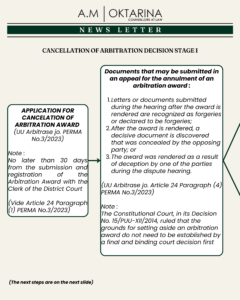
Di balik sifat final and binding yang melekat pada putusan arbitrase, hukum Indonesia tetap memberikan ruang pengawasan dalam batas tertentu terhadap putusan arbitrase. Ruang pengawasan tersebut hadir sebagai bentuk perlindungan hukum untuk memastikan bahwa proses arbitrase berjalan secara jujur, adil, dan sesuai dengan ketentuan hukum yang berlaku. Dengan demikian, meskipun arbitrase bertujuan memberikan penyelesaian sengketa yang cepat dan berkekuatan hukum tetap, tetap diperlukan mekanisme kontrol untuk mengantisipasi adanya cacat serius dalam proses maupun dasar putusan arbitrase. Putusan arbitrase yang telah dijatuhkan oleh lembaga arbitrase dapat dimohonkan pembatalan kepada Ketua Pengadilan Negeri dalam jangka waktu paling lama 30 (tiga puluh) hari sejak putusan arbitrase diserahkan dan didaftarkan kepada Panitera Pengadilan Negeri.
Ketentuan mengenai alasan pembatalan putusan arbitrase diatur secara khusus dalam Pasal 70 UU Arbitrase dan APS jo Pasal 24 ayat (4) PERMA No.3/2023. Berdasarkan ketentuan tersebut, permohonan pembatalan putusan arbitrase hanya dapat diajukan apabila diduga mengandung salah satu unsur sebagai berikut:
(1) “Surat atau dokumen yang diajukan dalam pemeriksaan setelah putusan dijatuhkan diakui palsu atau dinyatakan palsu;
(2) Setelah putusan diambil ditemukan dokumen yang bersifat menentukan, yang disembunyikan oleh pihak lawan; atau
(3) Putusan diambil dari hasil tipu muslihat yang dilakukan oleh salah satu pihak dalam pemeriksaan sengketa.” (Vide: Pasal 70 UU Arbitrase dan APS jo Pasal 24 ayat (4) PERMA No.3/2023)
Ketiga alasan tersebut bersifat limitatif. Artinya, pengadilan tidak dapat membatalkan putusan arbitrase di luar alasan yang telah ditentukan undang-undang. Dengan demikian, pihak yang kalah dalam arbitrase tidak dapat mengajukan pembatalan hanya karena tidak setuju terhadap pertimbangan hukum arbiter atau merasa dirugikan oleh amar putusan. Dalam konteks ini, pembatalan arbitrase merupakan extraordinary legal remedy atau upaya hukum luar biasa yang hanya dapat digunakan dalam keadaan tertentu yang menyangkut integritas proses arbitrase.
Selain mengatur mengenai alasan-alasan pembatalan putusan arbitrase, UU Arbitrase dan APS juga mengatur tata cara atau mekanisme pengajuan pembatalan putusan arbitrase. Pengaturan tersebut dimaksudkan untuk memastikan bahwa proses pembatalan dilakukan secara terbatas, cepat, dan tetap sejalan dengan karakter arbitrase sebagai forum penyelesaian sengketa yang mengedepankan efisiensi serta kepastian hukum. Mekanisme pembatalan putusan arbitrase diatur dalam Pasal 71 dan Pasal 72 UU Arbitrase dan APS. Pasal 71 UU Arbitrase dan APS mengatur bahwa:
“Permohonan pembatalan putusan arbitrase harus diajukan secara tertulis dalam waktu paling lama 30 (tiga puluh) hari terhitung sejak hari penyerahan dan pendaftaran putusan arbitrase kepada Panitera Pengadilan Negeri”
(Vide: Pasal 71 UU Arbitrase dan APS)
Sementara itu, Pasal 72 UU Arbitrase dan APS mengatur bahwa:
(1) “Permohonan pembatalan putusan arbitrase harus diajukan kepada Ketua Pengadilan Negeri.
(2) Apabila permohonan sebagaimana dimaksud dalam ayat (1) dikabulkan, Ketua Pengadilan Negeri menentukan lebih lanjut akibat pembatalan seluruhnya atau sebagian putusan arbitrase.
(3) Putusan atas permohonan pembatalan ditetapkan oleh Ketua Pengadilan Negeri dalam waktu paling lama 30 (tiga puluh) hari sejak permohonan sebagaimana dimaksud dalam ayat (1) diterima.
(4) Terhadap putusan Pengadilan Negeri dapat diajukan permohonan banding ke Mahkamah Agung yang memutus dalam tingkat pertama dan terakhir.
(5) Mahkamah Agung mempertimbangkan serta memutuskan permohonan banding sebagaimana dimaksud dalam ayat (4) dalam waktu paling lama 30 (tiga puluh) hari setelah permohonan banding tersebut diterima oleh Mahkamah Agung” (Vide: Pasal 72 UU Arbitrase dan APS) Dalam praktiknya, permohonan pembatalan putusan arbitrase diperiksa melalui mekanisme perdata khusus di Pengadilan Negeri. Akan tetapi, ruang lingkup pemeriksaannya tetap dibatasi hanya pada alasan-alasan pembatalan sebagaimana diatur dalam Pasal 70 UU Arbitrase dan APS. Oleh karena itu, hakim tidak diperkenankan memeriksa kembali pokok perkara, menilai ulang fakta-fakta sengketa, maupun menguji pertimbangan hukum arbiter. Dengan kata lain, pemeriksaan pembatalan arbitrase bukan merupakan forum untuk mengulang proses pembuktian atau memperdebatkan kembali substansi sengketa, melainkan semata-mata untuk menilai apakah terdapat cacat fundamental dalam proses pembentukan putusan arbitrase.
Selanjutnya, Pasal 25 PERMA No.3/2023 mengatur mengenai tata cara pengajuan permohonan pembatalan putusan arbitrase. Permohonan pembatalan putusan arbitrase diajukan kepada pengadilan negeri, sedangkan pembatalan putusan arbitrase syariah diajukan kepada Pengadilan Agama atau Mahkamah Syar’iyah. Permohonan tersebut diajukan dalam bentuk permohonan, bukan gugatan, sehingga prosesnya bersifat khusus dan terbatas. Selain itu, pengajuan permohonan dapat dilakukan baik secara langsung maupun secara elektronik sebagai bentuk penyesuaian terhadap sistem administrasi peradilan. Setelah permohonan didaftarkan, perkara akan diberikan nomor register khusus sesuai jenis pengadilannya, kemudian Ketua Pengadilan menunjuk majelis hakim untuk memeriksa dan mengadili permohonan tersebut, sebagaimana ketentuan berikut:
1. “Pembatalan putusan Arbitrase diajukan ke pengadilan negeri dalam bentuk permohonan.
2. Pembatalan putusan Arbitrase Syariah diajukan ke pengadilan agama/mahkamah syar’iyah dalam bentuk permohonan.
3. Permohonan sebagaimana dimaksud pada ayat (1) dan ayat (2),dapat diajukan secara langsung atau elektronik.
4. Penomoran perkara sebagaimana dimaksud pada ayat (1) dan ayat (2):
a. Pengadilan negeri dengan Nomor …../Pdt.Sus-Arb/20 …/PN…; atau b. Pengadilan agama dengan Nomor… Pdt.G -Arb/20…./PA/MS
5. Ketua Pengadilan menunjuk majelis hakim untuk mengadili permohonan dimaksud pada ayat (3).
6. Terhadap permohonan pembatalan pembatalan sebagaimana putusan Arbitrase /Arbitrase Syariah, pihak Termohon hanya dapat mengajukan tanggapan.
7. Proses mengadili sebagaimana dimaksud pada ayat (5) dan ayat (6) dilakukan secara sederhana, cepat dan biaya ringan.” (Vide Pasal 25 PERMA No.3/2023)
Dalam proses pemeriksaannya, pihak termohon hanya diberikan hak untuk menyampaikan tanggapan terhadap permohonan yang diajukan oleh pemohon. Hal ini menunjukkan bahwa pemeriksaan pembatalan arbitrase bukan merupakan pemeriksaan ulang terhadap pokok sengketa, melainkan hanya menilai ada atau tidaknya alasan pembatalan sebagaimana ditentukan undang-undang. Oleh karena itu, proses pemeriksaannya dilakukan secara sederhana, cepat, dan dengan biaya ringan agar tetap sejalan dengan prinsip arbitrase yang mengutamakan efisiensi dan kepastian hukum.
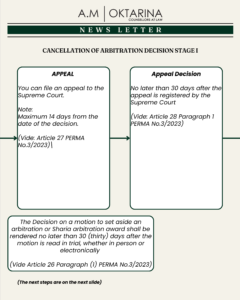
Selanjutnya, Pasal 26 ayat (1) PERMA No.3/2023 menyatakan bahwa: “Putusan permohonan pembatalan putusan Arbitrase /Arbitrase Syariah diucapkan paling lambat 30 (tiga puluh) Hari sejak permohonan dibacakan dalam persidangan secara langsung atau elektronik” (Vide: Pasal 26 ayat (1) PERMA No.3/2023 )
Ketentuan tersebut mengatur tahapan pemeriksaan permohonan pembatalan putusan arbitrase di pengadilan. putusan atas permohonan pembatalan wajib diucapkan paling lambat 30 hari sejak permohonan dibacakan dalam persidangan. Ketentuan ini menegaskan adanya pembatasan waktu agar proses pembatalan tidak berlangsung terlalu lama dan tidak menghilangkan tujuan arbitrase sebagai penyelesaian sengketa yang cepat.
Dalam Pasal 26 ayat (2) sampai dengan ayat (6) PERMA No.3/2023, menyatakan bahwa:
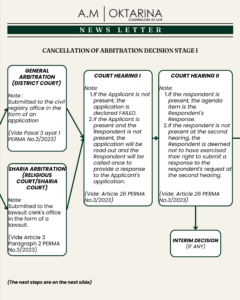
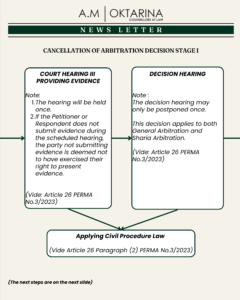
1. “Tahapan persidangan pemeriksaan permohonan pembatalan putusan Arbitrase/Arbitrase Syariah terdiri dari: a. sidang pertama untuk pembacaan permohonan; b. sidang kedua untuk tanggapan; c. putusan sela (jika ada); d. sidang dengan acara pembuktian; e. dan sidang pembacaan putusan.
2. Dalam hal Pemohon setelah dipanggil secara sah dan patut tidak hadir pada hari sidang pertama tanpa alasan yang sah, permohonan dinyatakan gugur.
3. Dalam hal Termohon setelah dipanggil secara sah dan patut tidak hadir tanpa alasan yang sah pada sidang pertama, sidang tetap dilanjutkan dengan agenda pembacaan permohonan Pemohon.
4. Terhadap Termohon yang tidak hadir dengan alasan yang sah dalam sidang pertama, Termohon dipanggil sekali lagi disertai lampiran permohonan guna memberikan hak bagi Termohon untuk menyampaikan tanggapan dalam sidang kedua.
5. Dalam hal Termohon setelah dipanggil tidak hadir dalam sidang kedua sebagaimana dimaksud pada ayat (5), Termohon dianggap tidak menggunakan haknya untuk menyampaikan tanggapan atas permohonan Pemohon.”
(Vide: Pasal 26 ayat (2) sampai dengan ayat (6) PERMA No.3/2023)
Ketentuan tersebut menjelaskan bahwa tahapan persidangan terdiri dari sidang pembacaan permohonan, sidang tanggapan, putusan sela apabila diperlukan, sidang pembuktian, dan sidang pembacaan putusan. Apabila pemohon tidak hadir pada sidang pertama tanpa alasan yang sah, maka permohonannya dinyatakan gugur. Sebaliknya, apabila termohon tidak hadir, persidangan tetap dapat dilanjutkan. Namun, apabila ketidakhadiran termohon disertai alasan yang sah, pengadilan memberikan kesempatan sekali lagi kepada termohon untuk hadir dan menyampaikan tanggapan pada sidang berikutnya. Jika tetap tidak hadir, termohon dianggap melepaskan haknya untuk memberikan tanggapan.
Pengaturan ini menunjukkan bahwa proses pembatalan arbitrase dirancang secara ketat dan efisien agar tidak berkembang menjadi proses litigasi biasa. Dengan demikian, pengadilan tidak dapat secara bebas membatalkan putusan arbitrase di luar alasan yang telah ditentukan undang-undang. Majelis hakim diberikan kewenangan untuk mempertimbangkan alasan pembatalan tersebut tanpa harus menunggu adanya putusan pengadilan lain yang mendasarinya.
Sementara itu, Pasal 27 PERMA No.3/2023mengatur mengenai upaya hukum terhadap putusan pembatalan arbitrase. Permohonan banding harus diajukan secara tertulis paling lambat 14 hari sejak putusan diucapkan atau diberitahukan kepada para pihak, serta wajib disertai memori banding yang dapat diajukan secara langsung maupun secara elektronik, sebagaimana ketentuan berikut:
1. “Terhadap putusan Pengadilan yang mengabulkan permohonan pembatalan putusan Arbitrase/Arbitrase Syariah, dapat diajukan permohonan banding ke Mahkamah Agung yang memutus dalam tingkat pertama dan terakhir.
2. Permohonan banding sebagaimana dimaksud pada ayat (1), dapat diajukan secara langsung atau elektronik.
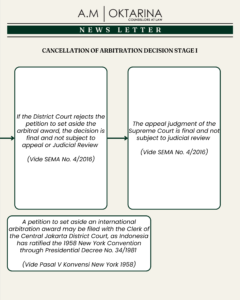
3. Terhadap putusan Pengadilan yang menolak permohonan pembatalan putusan Arbitrase /Arbitrase Syariah, tidak dapat diajukan upaya hukum apapun.
4. Permohonan banding ke Mahkamah Agung diajukan secara tertulis paling lambat 14 (empat belas) Hari sejak putusan diucapkan atau diberitahukan kepada para pihak.
5. Permohonan banding sebagaimana dimaksud pada ayat (4) diterima dan dicatat dalam buku register serta harus diajukan bersama-sama dengan memori banding.” (Vide Pasal 27 ayat (1) sampai dengan ayat (5) PERMA No.3/2023)
Apabila permohonan diajukan melewati tenggang waktu atau tidak memenuhi syarat formal, maka permohonan tersebut dinyatakan tidak memenuhi syarat formal oleh Panitera Pengadilan. Selanjutnya, ketua pengadilan menerbitkan penetapan dan mengirimkannya kepada Mahkamah Agung tanpa menyertakan berkas perkara, sebagaimana dijelaskan ketentuan Pasal 27 ayat (6) sampai dengan (10) PERMA No.3/2023, sebagai berikut: 1. “Permohonan yang diajukan sebagaimana dimaksud pada ayat (3)dan.’ atau permohonan yang diajukan melampaui tenggang waktu sebagaimana dimaksud pada ayat (4) darr/ atau ayat (5) dinyatakan tidak memenuhi syarat formal melalui surat keterangan Panitera Pengadilan.
2. Terhadap permohonan yang tidak memenuhi syarat formal sebagaimana dimaksud pada ayat (6), ketua Pengadilan menerbitkan penetapan dan penetapan tersebut dikirimkan ke Mahkamah Agung tanpa disertai berkas perkara serta kepada para pihak.
3. Paling lambat 3 (tiga) Hari sejak permohonan banding dicatat, Pengadilan memberitahukan adanya permohonan banding kepada Termohon banding.
4. Paling lambat 7 (tujuh) Hari sejak tanggal pemberitahuan kepada Termohon banding, Termohon banding dapat mengajukan kontra memori banding ke kepaniteraan Pengadilan.
5. Paling lambat 7 (tujuh) Hari sejak tenggang waktu sebagaimana dimaksud pada ayat (9) terlampaui, Panitera Pengadilan memberitahukan kepada para pihak untuk memeriksa kelengkapan berkas (inzage).”
(Vide Pasal 27 ayat (6) sampai dengan ayat (10) PERMA No.3/2023)
Ketentuan ini juga mengatur tata cara administrasi banding secara rinci, mulai dari pemberitahuan kepada termohon banding, pengajuan kontra memori banding, pemeriksaan kelengkapan berkas (inzage), hingga pengiriman berkas ke Mahkamah Agung. Seluruh tahapan tersebut dibatasi dengan jangka waktu tertentu guna menjaga efektivitas dan efisiensi penyelesaian perkara pembatalan arbitrase, sebagaimana dijelaskan dalam Pasal 27 ayat (11) dan (12) PERMA No.3/2023, sebagaimana berikut:
11. “Para pihak melakukan inzage paling lambat 3 (tiga) Hari sejak tanggal pemberitahuan inzage.
12. Berkas banding dikirim ke Mahkamah Agung paling lambat 25 (dua puluh lima) Hari sejak permohonan banding didaftarkan” (Vide Pasal 27 ayat (11) dan (12) PERMA No.3/2023)
Terakhir, Pasal 28 PERMA No.3/2023 menentukan bahwa Mahkamah Agung wajib memutus permohonan banding paling lambat 30 hari sejak perkara diregistrasi di Mahkamah Agung. Putusan Mahkamah Agung tersebut bersifat final dan tidak dapat diajukan upaya hukum apa pun.
1. “Mahkamah Agung memutuskan mempertimbangkan permohonan serta banding sebagaimana dimaksud dalam Pasal 27 paling lambat 30 (tiga puluh) Hari setelah permohonan banding tersebut diregistrasi oleh Mahkamah Agung.”
2. Putusan Mahkamah Agung sebagaimana dimaksud pada ayat (1) bersifat final dan tidak ada upaya hukum apapun.” (Vide: Pasal 28 PERMA No.3/2023)
Lebih lanjut, perkembangan penting terkait pembatalan putusan arbitrase di Indonesia juga tidak dapat dilepaskan dari Putusan MK Nomor 15/PUU-XII/2014 yang menguji Penjelasan Pasal 70 UU Arbitrase dan APS. Sebelum adanya putusan tersebut, Penjelasan Pasal 70 UU Arbitrase dan APS menyatakan bahwa alasan pembatalan putusan arbitrase “harus dibuktikan dengan putusan pengadilan”. Menurut Mahkamah Konstitusi, ketentuan tersebut berbeda dengan norma dalam Pasal 70 UU Arbitrase dan APS yang hanya mensyaratkan adanya “dugaan” mengenai unsur pemalsuan dokumen, ditemukannya dokumen baru yang menentukan, atau adanya tipu muslihat dalam proses arbitrase. Mahkamah menegaskan bahwa kata “diduga” bersifat hipotetis dan cukup menjadi dasar untuk mengajukan permohonan pembatalan, sedangkan frasa “harus dibuktikan dengan putusan pengadilan” justru mengubah makna norma menjadi sesuatu yang harus terlebih dahulu dipastikan melalui putusan pengadilan. (Vide halaman 3 dan 4 Putusan MK Nomor 15/PUU-XII/2014)
Mahkamah Konstitusi juga menilai bahwa Penjelasan Pasal 70 UU Arbitrase dan APS menimbulkan multitafsir, khususnya mengenai apakah pihak yang mengajukan pembatalan harus terlebih dahulu memperoleh putusan pengadilan sebelum mengajukan permohonan pembatalan arbitrase, ataukah pembuktian dilakukan langsung dalam proses pemeriksaan permohonan pembatalan itu sendiri. Menurut Mahkamah Konstitusi, apabila pihak pemohon diwajibkan melalui dua proses pengadilan, hal tersebut bertentangan dengan prinsip arbitrase yang cepat dan efisien, terlebih Pasal 71 UU Arbitrase dan APS membatasi pengajuan pembatalan hanya dalam waktu 30 (tiga puluh) hari sejak putusan arbitrase didaftarkan di Pengadilan Negeri. (Vide halaman 4 Putusan MK Nomor 15/PUU-XII/2014)
Berdasarkan pertimbangan tersebut, Mahkamah Konstitusi menyatakan bahwa Penjelasan Pasal 70 UU Arbitrase dan APS bertentangan dengan Pasal 28D ayat (1) UUD NRI Tahun 1945 yang menyatakan bahwa:
“setiap orang berhak atas pengakuan, jaminan, perlindungan, dan kepastian hukum yang adil serta perlakuan yang sama dihadapan hukum” (Vide: Pasal 28D ayat (1) UUD NRI Tahun 1945) Putusan ini mempertegas bahwa pembuktian alasan pembatalan dilakukan langsung dalam proses pemeriksaan permohonan pembatalan di Pengadilan Negeri tanpa perlu adanya putusan pengadilan lain terlebih dahulu, sehingga mekanisme pembatalan arbitrase tetap bersifat terbatas dan tidak menghilangkan prinsip final and binding dalam arbitrase. (Vide halaman 4 Putusan MK Nomor 15/PUU-XII/2014)
Dengan adanya Putusan MK Nomor 15/PUU-XII/2014 tersebut, mekanisme pembatalan putusan arbitrase di Indonesia menjadi lebih jelas dan sejalan dengan prinsip dasar arbitrase, yaitu cepat, sederhana, dan memberikan kepastian hukum. Putusan ini juga mempertegas bahwa pembatalan arbitrase tetap merupakan upaya hukum yang bersifat terbatas, sehingga tidak dapat digunakan untuk mengulang pemeriksaan pokok sengketa ataupun menilai kembali pertimbangan arbiter.
Pada akhirnya, prinsip final and binding tetap menjadi hal yang utama dalam sistem arbitrase di Indonesia. Prinsip tersebut memberikan kepastian hukum, efisiensi, serta jaminan penyelesaian sengketa yang lebih cepat dibandingkan proses litigasi pada umumnya. Namun demikian, demi menjaga integritas proses arbitrase, hukum Indonesia tetap menyediakan mekanisme pembatalan putusan arbitrase sebagai bentuk kontrol yang bersifat terbatas dan exceptional.
Melalui pengaturan dalam Pasal 70 sampai dengan Pasal 72 UU Arbitrase dan APS serta diperkuat oleh Putusan Mahkamah Konstitusi Nomor 15/PUU-XII/2014, dapat dilihat bahwa sistem hukum Indonesia berupaya menjaga keseimbangan antara kepastian hukum dan perlindungan terhadap due process of law. Dengan demikian, arbitrase tetap dipertahankan sebagai forum penyelesaian sengketa yang efektif, terpercaya, dan memberikan kepastian hukum bagi para pihak, khususnya dalam dunia bisnis dan perdagangan yang membutuhkan penyelesaian sengketa secara cepat dan final.
Bahwa terkait dengan Putusan Arbitrase yang berasal dari negara asing dapat juga didaftarkan dan dibatalkan di Pengadilan Negeri Jakarta Pusat, sebagaimana yang telah diatur dalam Pasal 7 Perma No. 3/2023. Mengenai permohonan pembatalan Putusan Arbitrase Internasional dapat juga dilakukan melalui Panitera Pengadilan Negeri Jakarta Pusat, mengingat Indonesia telah meratifikasi Konvensi New York 1958 mengenai Pengakuan dan Pelaksanaan Putusan Arbitrase Asing melalui Keppres 34/1981, yang mana dalam Pasal 5 Konvensi New York 1958 telah diatur yang pada intinya yaitu pengakuan dan pelaksanaan putusan hanya dapat ditolak jika pihak termohon mengajukan keberatan resmi kepada otoritas yang berwenang di tempat eksekusi tersebut diminta. (Vide Pasal V Konvensi New York 1958)
D. Kesimpulan Pada dasarnya, putusan arbitrase dalam sistem hukum Indonesia bersifat final and binding sebagaimana diatur dalam Pasal 60 UU Arbitrase dan APS. Sifat tersebut menegaskan bahwa putusan arbitrase memiliki kekuatan hukum tetap dan tidak dapat diajukan upaya hukum biasa seperti banding, kasasi, maupun peninjauan kembali. Meskipun demikian, hukum Indonesia tetap memberikan ruang terbatas untuk mengajukan pembatalan putusan arbitrase berdasarkan alasan-alasan tertentu yang diatur secara limitatif dalam Pasal 70 UU Arbitrase dan APS jo. Pasal 24 ayat (4) PERMA No. 3/ 2023. Mekanisme tersebut bukan dimaksudkan untuk memeriksa ulang pokok sengketa, melainkan untuk memastikan bahwa proses arbitrase berjalan secara jujur, adil, dan bebas dari unsur pemalsuan maupun tipu muslihat. Selain itu, Putusan MK Nomor 15/PUU-XII/2014 mempertegas bahwa pembuktian alasan pembatalan dilakukan langsung dalam proses pemeriksaan permohonan pembatalan di Pengadilan Negeri tanpa perlu adanya putusan pengadilan lain terlebih dahulu. Dengan demikian, mekanisme pembatalan arbitrase tetap bersifat terbatas dan tidak menghilangkan prinsip final and binding dalam arbitrase. | A. Introduction In the world of business and commerce, disputes are unavoidable, especially when parties have differing interests, contract interpretations, or expectations regarding a collaboration. To resolve these disputes, parties generally choose litigation or alternative dispute resolution, one of which is arbitration. Compared to the formal and time-consuming litigation process, arbitration is often chosen because it offers a faster, more confidential, and more flexible process, providing legal certainty for business actors.
Arbitration is an out-of-court dispute resolution mechanism widely used in business practice due to its speed and flexibility. In Indonesia, arbitration is regulated by Law Number 30 of 1999 concerning Arbitration and Alternative Dispute Resolution (the “Arbitration and APS Law”), with one of its institutions being the Indonesian National Arbitration Board (“BANI”).
Furthermore, based on the provisions of Supreme Court Regulation Number 3 of 2023 concerning Procedures for Appointing Arbitrators by the Court, the Right of Recusal, and the Examination of Petition for Enforcement and Cancellation of Arbitration Decision, arbitration in Indonesia is essentially divided into arbitration and sharia arbitration. This distinction also impacts the court’s authority in examining petition for annulment of arbitration decision. For arbitration decision, annulment petition are filed and examined by the District Court. Meanwhile, for sharia arbitration decision, annulment petition are filed with the Religious Court and the Sharia Court in certain regions. This division of authority demonstrates that the Indonesian legal system has accommodated the characteristics of disputes resolved through arbitration mechanisms, both general and sharia-based.
In principle, arbitration decisions are final and binding, as stipulated in Article 60 of the Arbitration and APS Law, and therefore cannot be appealed, cassated, or judicially reviewed. However, Indonesian law still provides limited scope for an annulment of an arbitration decision based on specific grounds, as stipulated in Article 70 of the Arbitration and APS Law.
B. Legal Basis 1. The 1945 Constitution of the Republic of Indonesia (“UUD NRI 1945”); 2. Law Number 30 of 1999 concerning Arbitration and Alternative Dispute Resolution (“Arbitration and APS Law”); 3. Constitutional Court Decision Number 15/PUU-XII/2014 (“MK Decision Number 15/PUU-XII/2014”); 4. Supreme Court Regulation Number 3 of 2023 concerning Procedures for Appointing Arbitrators by the Court, the Right of Objection, Examination of Applications for Enforcement and Cancellation of Arbitration Decision (“PERMA No. 3/2023”); 5. Presidential Decree No. 34 of 1981 Ratifying the “Convention on the Recognition and Enforcement of Foreign Arbitral Awards,” Signed in New York on June 10, 1958, and Which Entered into Force on June 7, 1959 (“Keppres 34/1981”); 6. Supreme Court Circular Letter No. 4 of 2016 on the Enforcement of the Formulations of the Supreme Court Chamber Plenary Meeting of 2016 as Guidelines for Task Execution for Courts (“SEMA No. 4/2016”); 7. 1958 New York Convention on the Recognition and Enforcement of Foreign Arbitral Awards (“1958 New York Convention”);
C. Discussion In dispute resolution through arbitration, there are several fundamental principles that characterize and differentiate it from litigation mechanisms in court. These principles are designed to ensure a more effective and efficient dispute resolution process and provide legal certainty for the parties. One of the main characteristics of arbitration is the principle of finality and binding. This principle emphasizes that an arbitral award is essentially intended to resolve the dispute completely without re-examining the underlying issue. The principle of finality and binding is a key foundation of arbitration. Article 60 of the Arbitration and APS Law states: “An arbitration award is final and has permanent legal force and is binding on the parties.” The meaning of “final” indicates that an arbitration award is not subject to ordinary legal remedies as in the Indonesian litigation system. Meanwhile, “binding” means that the parties are obliged to implement the award voluntarily and in good faith.
This principle stems from the principle of freedom of contract, and all legally concluded agreements are valid as law for those who make them (pacta sunt servanda), where the parties consciously choose arbitration as the forum for dispute resolution. By choosing arbitration, the parties are deemed to have waived their right to resolve the dispute through a public court.
Despite the final and binding nature of arbitral decision, Indonesian law still provides for a certain degree of oversight of arbitral decision. This oversight serves as a form of legal protection to ensure that the arbitration process is conducted honestly, fairly, and in accordance with applicable law. Therefore, although arbitration aims to provide expeditious and legally binding dispute resolution, a control mechanism is still necessary to anticipate serious flaws in the process or the basis of the arbitration award. An annulment of an arbitration award rendered by an arbitration institution may be requested from the Head of the District Court within a maximum of 30 (thirty) days from the date the arbitration award is submitted and registered with the District Court Clerk.
The provisions regarding the reasons for annulling an arbitration award are specifically regulated in Article 70 of the Arbitration and APS Law in conjunction with Article 24 paragraph (4) of PERMA No. 3/2023. Based on these provisions, an petition for annulment of an arbitration award may only be submitted if it is suspected to contain one of the following elements:
(1) “Letters or documents submitted in the examination after the decision has been rendered are recognized as forged or declared to be forged;
(2) After the decision has been rendered, a decisive document is discovered that was concealed by the opposing party; or
(3) The decision was rendered as a result of deception perpetrated by one of the parties during the dispute examination.” (Vide: Article 70 of the Arbitration and APS Law jo. with Article 24 paragraph (4) of PERMA No. 3/2023)
These three reasons are limited. This means that the court cannot annul an arbitration award for reasons other than those stipulated by law. Therefore, the losing party in an arbitration cannot file for annulment simply because they disagree with the arbitrator’s legal reasoning or feel aggrieved by the decision. In this context, annulment of arbitration is an extraordinary legal remedy that can only be used in certain circumstances that affect the integrity of the arbitration process.
In addition to regulating the grounds for annulling an arbitral award, the Arbitration and APS Law also regulate the procedures or mechanisms for filing an annulment request. These regulations are intended to ensure that the annulment process is carried out in a limited, expeditious manner, and remains in line with the character of arbitration as a dispute resolution forum that prioritizes efficiency and legal certainty. The mechanism for annulment of an arbitral award is regulated in Articles 71 and 72 of the Arbitration and the APS Law:
“A petition to annul an arbitration award must be submitted in writing within a maximum of 30 (thirty) days from the date the arbitration award was submitted and registered with the District Court Clerk.”
(Vide: Article 71 of the Arbitration and APS Law)
Meanwhile, Article 72 of the Arbitration and APS Law stipulates that:
(1) “An petition to annul an arbitration award must be submitted to the Head of the District Court.
(2) If the petition referred to in paragraph (1) is granted, the Head of the District Court shall further determine the consequences of the annulment of all or part of the arbitration award.
(3) The Head of the District Court shall issue a decision on the annulment petition within 30 (thirty) days of receipt of the petition referred to in paragraph (1).
(4) An appeal may be filed against the District Court decision to the Supreme Court, which rules at the first and final instance.
(5) The Supreme Court shall consider and decide on the appeal application referred to in paragraph (4) within 30 (thirty) days of receipt of the appeal petition by the Supreme Court.”
(Vide: Article 72 of the Arbitration and APS Law) In practice, petition for annulment of an arbitration award are examined through a special civil mechanism in the District Court. However, the scope of the examination remains limited to the grounds for annulment as stipulated in Article 70 of the Arbitration Law and the Arbitration and APS Law. Therefore, the judge is not permitted to re-examine the merits of the case, re-evaluate the facts of the dispute, or examine the arbitrator’s legal reasoning. In other words, an annulment examination is not a forum for rehashing the evidentiary process or re-debating the substance of the dispute, but rather solely to assess whether there are fundamental flaws in the arbitration award-making process.
Furthermore, Article 25 of PERMA No. 3/2023 regulates the procedures for submitting a petition for annulment of an arbitration award. An petition for annulment of an arbitration award is submitted to a district court, while an petition for annulment of a Sharia arbitration award is submitted to a Religious Court or Sharia Court. These petition are submitted in the form of an petition, not a lawsuit, so the process is specific and limited. Furthermore, petition can be submitted either in person or electronically as a form of adjustment to the judicial administration system. After the petition is registered, the case will be assigned a special registration number according to the type of court. The Head of Court then appoints a panel of judges to examine and adjudicate the petition, as stipulated below:
1. “Annulment of an arbitration award shall be submitted to the district court in the form of a petition.
2. Annulment of a Sharia Arbitration award shall be submitted to a religious court/Sharia court in the form of a petition.
3. The petition referred to in paragraphs (1) and (2) may be submitted in person or electronically.
4. Case numbering as referred to in paragraphs (1) and (2):
a. District court with Number …../Pdt.Sus-Arb/20 …/PN…; or b. Religious court with Number… Pdt.G -Arb/20…./PA/MS
5. The Head of Court shall appoint a panel of judges to adjudicate the petition referred to in paragraph (3).
6. The Respondent may only submit a response to a petition for annulment of an arbitration/Sharia Arbitration award.
7. The adjudication process referred to in paragraphs (5) and (6) shall be simple, expeditious, and inexpensive.”
(Vide Article 25 PERMA No.3/2023)
During the examination process, the respondent is only given the right to submit a response to the petitioner’s petition. This demonstrates that the examination of an arbitration annulment is not a re-examination of the underlying dispute, but rather merely an assessment of the existence of grounds for annulment as stipulated by law. Therefore, the examination process is conducted simply, quickly, and at a low cost to remain in line with arbitration principles that prioritize efficiency and legal certainty.
Furthermore, Article 26 paragraph (1) of PERMA No. 3/2023 states that: “The decision on a petition to annul an arbitration/Sharia arbitration award must be pronounced no later than 30 (thirty) days after the petition is read in person or electronically in court.” (Vide: Article 26 paragraph (1) PERMA No. 3/2023)
These provisions govern the stages of the court hearing for an annulment petition. A decision on an annulment petition must be rendered no later than 30 days after the petition is read in court. This provision emphasizes the time limit to ensure the annulment process does not drag on unduly and does not undermine the purpose of arbitration as a speedy dispute resolution.
In Article 26 paragraph (2) to paragraph (6) of PERMA No. 3/2023, it states that:
1. “The stages of the trial for an petition to annul an Arbitration/Sharia Arbitration decision consist of: a. the first hearing for the reading of the petition; b. the second hearing for the response; c. the interlocutory decision (if any); d. the hearing with the presentation of evidence; e. and the hearing for the reading of the decision.
2. If the Plaintiff, after being legally and properly summoned, fails to appear on the first hearing day without a valid reason, the petition shall be dismissed.
3. If the Respondent, after being legally and properly summoned, fails to appear without a valid reason at the first hearing, the hearing shall continue with the reading of the Petitioner petition.
4. If a Respondent fails to appear for a valid reason at the first hearing, the Respondent shall be summoned again, accompanied by an attachment to the petition, to grant the Respondent the right to submit a response at the second hearing.
5. If the Respondent, after being summoned, fails to appear at the second hearing as referred to in paragraph (5), the Respondent shall be deemed to have not exercised its right to submit a response to the Petitioner petition.”
(Vide: Article 26 paragraph (2) to paragraph (6) PERMA No.3/2023)
These provisions explain that the trial stages consist of a hearing to read the petition, a hearing to respond, an interim decision if necessary, a hearing to present evidence, and a hearing to pronounce the verdict. If the plaintiff is absent from the first hearing without a valid reason, the petition is declared dismissed. Conversely, if the respondent is absent, the trial may continue. However, if the respondent’s absence is accompanied by a valid reason, the court will give the respondent another opportunity to attend and submit a response at the next hearing. If the respondent still does not appear, the respondent is deemed to have waived their right to provide a response.
This regulation demonstrates that the arbitration annulment process is rigorously and efficiently designed to prevent it from degenerating into ordinary litigation. Therefore, the court cannot freely annul an arbitration award for reasons other than those stipulated by law. The panel of judges is empowered to consider the reasons for the annulment without having to wait for a court decision to provide a basis for the annulment.
Meanwhile, Article 27 of Supreme Court Regulation No. 3/2023 regulates legal remedies against an arbitration annulment decisions. An appeal must be submitted in writing no later than 14 days after the decision is pronounced or notified to the parties, and must be accompanied by an appeal memorandum, which can be submitted in person or electronically, as follows:
1. “An appeal may be filed against a court decision granting an petition for annulment of an arbitration/Sharia Arbitration award to the Supreme Court, which ruled at the first and final instance.
2. An appeal as referred to in paragraph (1) may be filed in person or electronically.
3. No legal remedy may be filed against a court decision rejecting an petition for annulment of an arbitration/Sharia Arbitration award.
4. An appeal to the Supreme Court must be submitted in writing no later than 14 (fourteen) days after the decision is pronounced or notified to the parties.
5. An appeal as referred to in paragraph (4) is received and recorded in the register and must be filed together with the appeal memorandum.” (Vide Article 27 paragraphs (1) to (5) of PERMA No. 3/2023)
If the petition is submitted after the deadline or does not meet the formal requirements, the Court Clerk will declare the petition does not meet the formal requirements. The head of court will then issue a decision and send it to the Supreme Court without including the case files, as explained in Article 27 paragraphs (6) to (10) of PERMA No. 3/2023, as follows:
1. “An petition submitted as referred to in paragraph (3) and/or an petition submitted beyond the deadline referred to in paragraph (4) and/or paragraph (5) shall be declared not to meet the formal requirements by means of a statement from the Court Clerk.
2. For petition that do not meet the formal requirements as referred to in paragraph (6), the head of Court shall issue a decision, which shall be sent to the Supreme Court without the case files and to the parties.
3. No later than 3 (three) days after the appeal is recorded, the Court shall notify the Respondent of the appeal of the petition.
4. No later than 7 (seven) days after the date of notification to the Respondent, the Respondent may file a counter-appeal memorandum with the Court Clerk’s Office.
5. No later than 7 (seven) days after the deadline as referred to in paragraph (9) has elapsed, the Court Clerk shall notify the parties to check the completeness of the files (inzage).”
(Vide Article 27 paragraphs (6) to (10) of PERMA No. 3/2023)
This provision also regulates the administrative procedures for appeals in detail, starting from notification to the respondent, submission of a counter-appeal memorandum, checking the completeness of the files (inzage), and sending the files to the Supreme Court. All of these stages are limited by a certain time period to ensure the effectiveness and efficiency of resolving arbitration annulment cases, as explained in Article 27 paragraphs (11) and (12) of PERMA No. 3/2023, as follows:
11. “The parties shall submit an inzage no later than 3 (three) days from the date of the inzage notification.
12. The appeal documents shall be sent to the Supreme Court no later than 25 (twenty-five) days from the date the appeal request is registered.” (Vide Article 27 paragraphs (11) and (12) of PERMA No. 3/2023)
Finally, Article 28 of PERMA No. 3/2023 stipulates that the Supreme Court must rule on an appeal no later than 30 days after the case is registered with the Supreme Court. The Supreme Court’s decision is final and no legal remedy is available.
1. “The Supreme Court shall decide to consider the application and appeal as referred to in Article 27 no later than 30 (thirty) days after the appeal is registered by the Supreme Court.”
2. The Supreme Court’s decision as referred to in paragraph (1) is final and no legal remedy is available.” (Vide: Article 28 PERMA No. 3/2023)
Furthermore, important developments related to the annulment of arbitral decision in Indonesia cannot be separated from Constitutional Court Decision No. 15/PUU-XII/2014, which reviewed the Explanation to Article 70 of the Arbitration and APS Law. Prior to this decision, the Explanation to Article 70 of the Arbitration and APS Law stated that the grounds for annulment of an arbitration award “must be proven by a court decision.” According to the Constitutional Court, this provision differs from the norm in Article 70 of the Arbitration Law and APS, which only requires an “allegation” regarding document falsification, the discovery of new, decisive documents, or fraud in the arbitration process. The Court emphasized that the word “alleged” is hypothetical and sufficient basis for filing an annulment request, while the phrase “must be proven by a court decision” actually changes the meaning of the norm to something that must first be confirmed by a court decision. (See pages 3 and 4 of Constitutional Court Decision No. 15/PUU-XII/2014)
The Constitutional Court also considered that the Explanation to Article 70 of the Arbitration and APS Law was open to multiple interpretations, particularly regarding whether the party requesting annulment must first obtain a court decision before filing the annulment request, or whether the evidence must be presented directly during the examination of the annulment request itself. According to the Constitutional Court, requiring the plaintiff party to go through two court processes violates the principle of expeditious and efficient arbitration. Furthermore, Article 71 of the Arbitration and APS Law limits the annulment request to 30 (thirty) days from the date the arbitration decision is registered with the District Court. (See page 4 of Constitutional Court Decision Number 15/PUU-XII/2014)
Based on these considerations, the Constitutional Court declared that the Explanation to Article 70 of the Arbitration and APS Law contradicts Article 28D paragraph (1) of the UUD NRI 1945, which states:
“Everyone has the right to recognition, guarantees, protection, and certainty of just law, as well as equal treatment before the law.” (Vide: Article 28D paragraph (1) of the 1945 UUD NRI 1945)
This decision emphasizes that the basis for annulment must be established directly during the examination of the annulment petition in the District Court without the need for a prior court decision. Therefore, the annulment mechanism for arbitration remains limited and does not eliminate the principle of finality and binding in arbitration.
(Vide page 4 of Constitutional Court Decision Number 15/PUU-XII/2014)
With Constitutional Court Decision Number 15/PUU-XII/2014, the annulment mechanism for arbitration decision in Indonesia has become clearer and aligns with the basic principles of arbitration: speed, simplicity, and legal certainty. This decision also confirms that the cancellation of arbitration remains a limited legal remedy, so it cannot be used to repeat the examination of the main dispute or re-evaluate the arbitrator’s considerations.
Ultimately, the final and binding principle remains paramount in the Indonesian arbitration system. This principle provides legal certainty, efficiency, and guarantees faster dispute resolution compared to traditional litigation. However, to maintain the integrity of the arbitration process, Indonesian law still provides a mechanism for annulling an arbitration award as a limited and exceptional form of control.
Through the provisions in Articles 70 to 72 of the Arbitration and APS Law, reinforced by Constitutional Court Decision No. 15/PUU-XII/2014, it is clear that the Indonesian legal system strives to maintain a balance between legal certainty and protection of due process. Thus, arbitration remains an effective and reliable dispute resolution forum, providing legal certainty for the parties, particularly in the business and trade sectors, which require expeditious and final dispute resolution.
Arbitration awards issued in foreign countries may also be registered and set aside at the Central Jakarta District Court, as provided for in Article 7 of Supreme Court Regulation No. 3/2023. Regarding applications for the annulment of international arbitration awards, these may also be filed through the Clerk of the Central Jakarta District Court, given that Indonesia has ratified the 1958 New York Convention on the Recognition and Enforcement of Foreign Arbitral Awards via Presidential Decree No. 34/1981, wherein Article 5 of the 1958 New York Convention provides, in essence, that recognition and enforcement of an award may only be refused if the respondent files a formal objection with the competent authority in the place where enforcement is sought. (Vide Article V of the 1958 New York Convention)
D. Conclusion In essence, arbitration decisions in the Indonesian legal system are final and binding as stipulated in Article 60 of the Arbitration and APS Law. This nature confirms that arbitration decisions have permanent legal force and cannot be submitted to ordinary legal remedies such as appeals, cassation, or judicial review. However, Indonesian law still provides limited space to file for annulment of arbitration decisions based on certain reasons regulated in a limited manner in Article 70 of the Arbitration and APS Law in conjunction with Article 24 paragraph (4) of PERMA No. 3/ 2023. This mechanism is not intended to re-examine the subject matter of the dispute, but rather to ensure that the arbitration process runs honestly, fairly, and is free from elements of forgery or deception. In addition, Constitutional Court Decision Number 15/PUU-XII/2014 emphasizes that proving the reasons for annulment is carried out directly during the examination process of the annulment request at the District Court without the need for a prior court decision. Thus, the arbitration annulment mechanism remains limited and does not eliminate the final and binding principle in arbitration. |
PEMBATALAN PUTUSAN ARBITRASE TINGKAT I/CANCELLATION OF ARBITRATION DECISIONSTAGE I
CANCELLATION OF ARBITRATION DECISION STAGE I
For further information, please contact: